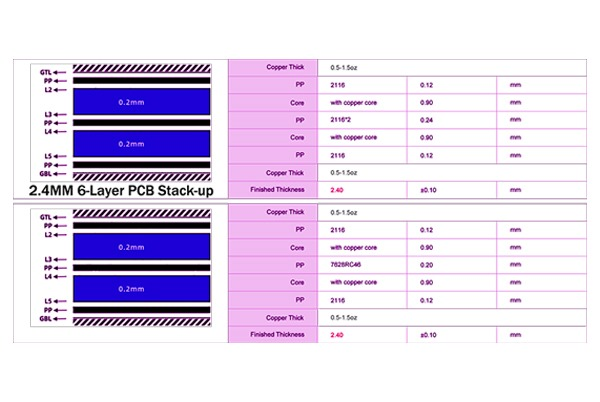
A PCB stackup defines the arrangement of copper layers, prepregs, cores, and dielectric materials within a printed circuit board.
While often overlooked during early development, stackup design is one of the most important factors affecting:
- Signal integrity
- Controlled impedance
- EMI performance
- Power distribution
- Thermal behavior
- Manufacturing reliability
A well-designed stackup helps prevent costly redesigns and improves both electrical and mechanical performance.
Related Reading: PCB Manufacturing Process
Table of Contents
Why PCB Stackup Design Matters
Many PCB problems originate from poor layer planning rather than poor routing.
Common issues include:
- Impedance mismatch
- Excessive EMI
- Crosstalk
- Power instability
- PCB warpage
- Via reliability problems
A proper stackup establishes the foundation for successful PCB design.
Main Elements of a PCB Stackup
Copper Layers
Copper layers carry:
- Signals
- Power
- Ground references
Typical copper thicknesses include:
| Copper Weight | Thickness |
|---|---|
| 0.5 oz | 17 μm |
| 1 oz | 35 μm |
| 2 oz | 70 μm |
| 3 oz | 105 μm |
Higher copper weight improves current-carrying capability but affects impedance calculations.
Core Materials
The core provides structural support.
Functions include:
- Mechanical stability
- Dielectric separation
- Thermal performance
Material selection significantly affects signal quality.
Internal Link: High Frequency PCB Material Selection
Prepreg Layers
Prepreg acts as the bonding material between cores.
During lamination:
- Resin melts
- Layers bond together
- Final dielectric thickness is established
Prepreg characteristics directly influence impedance control.
Ground Planes
Ground planes provide:
- Return current paths
- Noise reduction
- EMI suppression
Continuous reference planes are essential for high-speed signals.
Power Planes
Power planes distribute current efficiently while reducing voltage fluctuations.
Benefits include:
- Lower impedance
- Improved power integrity
- Better thermal distribution
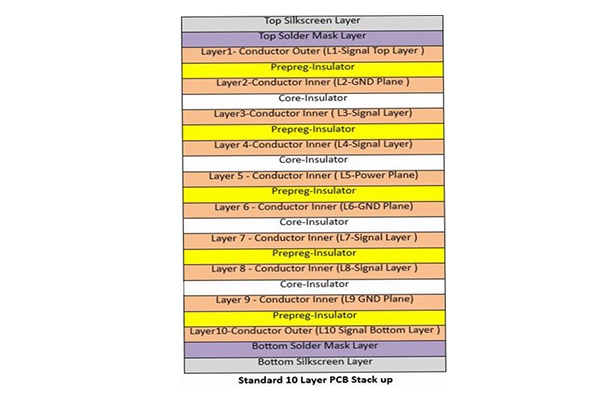
Common PCB Stackup Structures
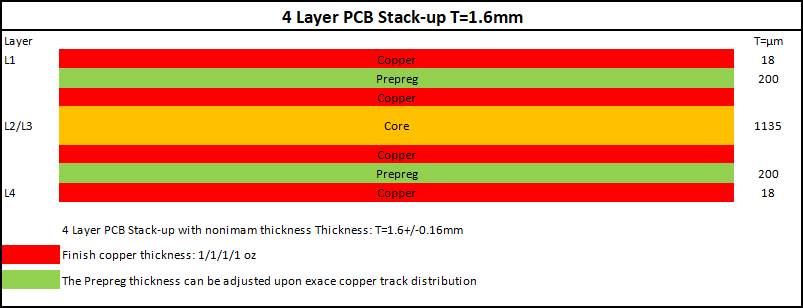
4-Layer PCB Stackup
A common arrangement is:
Signal
Ground
Power
Signal
Advantages:
- Cost-effective
- Good EMI control
- Suitable for many industrial products
Applications:
- Embedded systems
- Industrial controls
- Consumer electronics
Related Reading: 4 Layer PCB
6-Layer PCB Stackup
Typical configuration:
Signal
Ground
Signal
Power
Ground
Signal
Benefits:
- Better signal isolation
- Improved impedance control
- Reduced EMI
Commonly used in:
- Communication equipment
- Industrial automation
- Networking products
8-Layer PCB Stackup
Typical arrangement:
Signal
Ground
Signal
Power
Ground
Signal
Ground
Signal
Advantages:
- Excellent signal integrity
- High routing density
- Reduced crosstalk
Applications:
- Servers
- High-speed communication
- Medical equipment
10-Layer and Above
Higher layer counts support:
- HDI routing
- Complex processors
- High-speed buses
- RF integration
Internal Link: Multilayer PCB Supplier
Stackup Design for Signal Integrity
Keep Signal Layers Adjacent to Ground Planes
This creates:
- Stable return paths
- Lower EMI
- Controlled impedance
Poor reference plane placement is one of the most common design mistakes.
Minimize Loop Area
Smaller current loops reduce:
- Radiation
- Noise
- Susceptibility to interference
Control Layer Transitions
Every via transition introduces:
- Discontinuities
- Reflection
- Potential signal degradation
Internal Link: PCB Via Failure Analysis
Stackup Design for Controlled Impedance
Controlled impedance depends on:
- Trace width
- Dielectric thickness
- Copper thickness
- Material Dk
Engineers should calculate impedance before routing begins.
Common targets include:
| Interface | Typical Impedance |
|---|---|
| USB | 90 Ω Differential |
| Ethernet | 100 Ω Differential |
| PCIe | 85 Ω Differential |
| DDR | 40–60 Ω Single Ended |
Stackup Design for EMI Reduction
EMI performance improves when:
Ground Planes Remain Continuous
Avoid:
- Large splits
- Plane interruptions
- Unnecessary cutouts
High-Speed Signals Stay Close to References
This minimizes:
- Radiation
- Crosstalk
- Signal loss
Power and Ground Layers Are Properly Coupled
Closely spaced planes create distributed capacitance.
Benefits include:
- Improved power integrity
- Reduced switching noise
Stackup Design for Manufacturability
Electrical performance alone is not enough.
The stackup must also be manufacturable.
Important considerations include:
Symmetrical Layer Structure
Balanced designs reduce:
- Warpage
- Internal stress
- Reliability failures
Internal Link: PCB Warpage and Reflow Deformation
Balanced Copper Distribution
Uneven copper can cause:
- Lamination stress
- Delamination
- Dimensional instability
Internal Link: PCB Delamination Causes and Prevention
Appropriate Dielectric Thickness
Avoid unnecessarily thin dielectric layers that increase manufacturing difficulty.
How to Design an Effective PCB Stackup
- Step 1
Define:
. Signal speed
. Layer count
. Power requirements - Step 2
Select suitable materials based on:
. Frequency
. Thermal requirements
. Reliability targets
Related Reading: High Frequency PCB Material Selection - Step 3
Allocate dedicated ground planes early.
- Step 4
Determine impedance requirements before routing.
- Step 5
Review manufacturability with your PCB fabrication partner.
- Step 6
Verify performance using simulation tools.
Common PCB Stackup Mistakes
Routing Without Stackup Planning
Often leads to impedance problems.
Insufficient Ground Layers
Results in:
- EMI issues
- Poor signal integrity
Asymmetrical Structures
Increase warpage risk.
Excessive Layer Changes
Create unnecessary signal discontinuities.
Ignoring Material Properties
Can produce unreliable impedance performance.
FAQ
A: The required layer count depends on routing density, signal speed, and power distribution requirements.
A: Stackup affects signal integrity, EMI, manufacturability, and reliability.
A: No. Accurate impedance calculations require a defined stackup structure.
A: Generally, signal layers should be adjacent to continuous reference planes.
A: Before PCB layout starts. Early stackup planning prevents costly redesigns later.
Conclusion
PCB stackup design is one of the most important decisions in PCB development.
A properly engineered stackup improves:
- Signal integrity
- Impedance control
- EMI performance
- Reliability
- Manufacturability
By combining sound electrical design principles with manufacturing considerations, engineers can create PCB designs that perform reliably from prototype through mass production.
 EN
EN  PT
PT  AR
AR  DE
DE  FR
FR  ES
ES