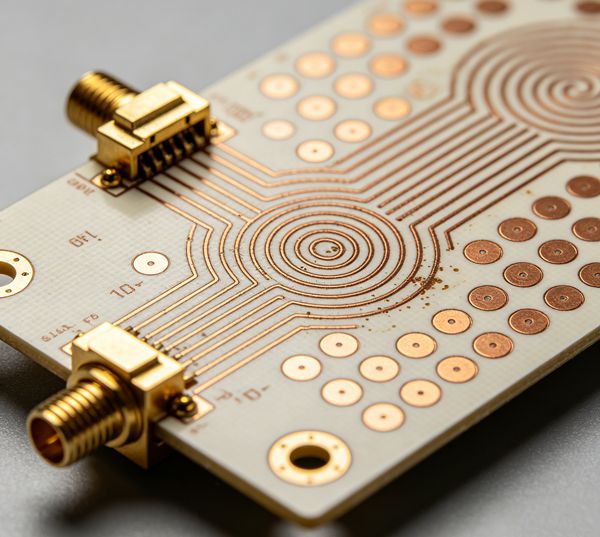
As operating frequencies continue to increase, PCB material selection becomes one of the most important design decisions in RF and high-speed electronics.
At frequencies above several gigahertz, signal performance is influenced not only by PCB layout but also by the electrical properties of the laminate itself.
A material that performs well in a low-speed industrial controller may be completely unsuitable for a 24 GHz radar system or a 56 Gbps networking platform.
Choosing the correct PCB material helps engineers achieve:
- Lower insertion loss
- Stable impedance control
- Better signal integrity
- Reduced EMI
- Improved thermal reliability
Related Reading: High Frequency PCB Supplier
Table of Contents
Why Material Selection Matters in High Frequency PCB Design
In traditional low-frequency circuits, standard FR4 materials are usually sufficient.
However, as frequencies increase, dielectric losses become a significant factor.
Poor material selection may result in:
- Excessive signal attenuation
- Increased jitter
- Impedance instability
- Reduced communication distance
- Lower system reliability
For RF and microwave designs, the PCB substrate effectively becomes part of the electrical circuit.
Key Material Parameters Engineers Should Evaluate
Dielectric Constant (Dk)
The dielectric constant determines how electromagnetic signals propagate through the PCB.
A stable Dk is important because it affects:
- Controlled impedance
- Signal propagation delay
- Antenna performance
- Differential pair routing
Typical values include:
| Material | Dk |
|---|---|
| Standard FR4 | 4.2–4.8 |
| High-Speed FR4 | 3.5–4.2 |
| Rogers RO4350B | 3.48 |
| Rogers RO4003C | 3.38 |
| PTFE Materials | 2.1–2.7 |
Lower Dk materials generally support faster signal transmission.
Dissipation Factor (Df)
Df represents dielectric loss.
The lower the Df value, the less signal energy is lost during transmission.
Typical comparison:
| Material | Df |
|---|---|
| Standard FR4 | 0.015–0.025 |
| High-Speed FR4 | 0.008–0.015 |
| RO4350B | 0.0037 |
| PTFE | 0.0009–0.002 |
As data rates increase, Df becomes one of the most critical selection criteria.
Glass Transition Temperature (Tg)
Tg defines the temperature at which laminate properties begin changing significantly.
Higher Tg materials provide:
- Better thermal stability
- Improved reliability
- Reduced risk of delamination
This is especially important for:
- Lead-free assembly
- Automotive electronics
- Industrial equipment
Internal Link: PCB Delamination Causes and Prevention
Coefficient of Thermal Expansion (CTE)
CTE measures how much a material expands when heated.
Large CTE differences between copper and laminate can cause:
- Via cracking
- Barrel cracking
- Delamination
Lower CTE materials generally offer better reliability.
Internal Link: PCB Via Failure Analysis
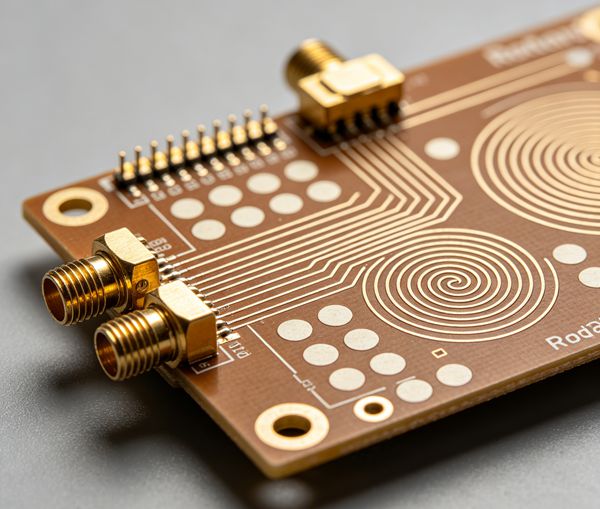
Common High Frequency PCB Materials
Standard FR4
FR4 remains the most widely used PCB material due to its low cost.
Advantages:
- Economical
- Widely available
- Suitable for many industrial applications
Limitations:
- Higher dielectric loss
- Dk variation
- Limited performance above several GHz
Typical applications:
- Industrial controls
- Consumer electronics
- General-purpose PCBs
High-Speed FR4
Enhanced FR4 formulations provide:
- Lower loss
- Better Dk stability
- Improved thermal performance
Common applications:
- Networking equipment
- Servers
- High-speed digital systems
Rogers RO4350B
One of the most popular RF laminates.
Benefits include:
- Low loss
- Stable Dk
- Good manufacturability
- Competitive cost compared with PTFE
Typical applications:
- RF modules
- Base stations
- Automotive radar
Rogers RO4003C
RO4003C is widely used in microwave applications.
Advantages:
- Excellent electrical stability
- Lower loss than FR4
- Consistent impedance performance
Applications include:
- Antennas
- RF amplifiers
- Communication equipment
PTFE-Based Materials
PTFE materials provide some of the lowest loss characteristics available.
Advantages:
- Extremely low Df
- Excellent RF performance
- Suitable for millimeter-wave designs
Challenges:
- Higher cost
- More complex processing
- Specialized fabrication requirements
Related Reading: Multilayer PCB Supplier
Material Selection by Application
5G Infrastructure
Recommended:
- RO4350B
- RO4003C
- Low-loss hybrid laminates
Key focus:
- Low insertion loss
- Stable impedance
Automotive Radar
Recommended:
- RO3003
- RO4835
- Advanced automotive RF laminates
Focus areas:
- Reliability
- Thermal stability
- Environmental resistance
Internal Link: Automotive PCBA Reliability Design
High-Speed Networking
Recommended:
- Megtron series
- Isola Tachyon
- High-speed FR4
Key requirements:
- Low jitter
- Signal integrity
- Controlled impedance
Aerospace and Defense
Recommended:
- PTFE laminates
- Advanced RF composites
Priority:
- Reliability
- Extreme environmental performance
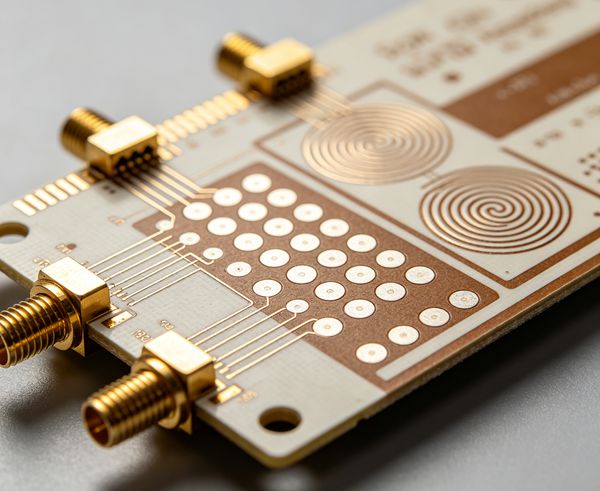
How to Choose the Right High Frequency PCB Material
- Step 1: Determine Operating Frequency
Material requirements increase significantly above:
. 2 GHz
. 6 GHz
. 24 GHz
. 77 GHz - Step 2: Evaluate Signal Loss Budget
Calculate allowable insertion loss before selecting laminate materials.
- Step 3: Consider Manufacturing Capability
Not every PCB fabricator can process advanced RF materials efficiently.
Internal Link: PCB Manufacturing Process - Step 4: Balance Performance and Cost
The highest-performance material is not always necessary.
Many applications perform well using:
. High-speed FR4
. Hybrid stackups
. Selective RF laminates - Step 5: Verify Reliability Requirements
Evaluate:
. Thermal cycling
. Moisture resistance
. Long-term stability
FAQ
A: For lower-frequency RF applications, yes. Higher-frequency systems often require specialized low-loss materials.
A: RO4350B and similar low-loss laminates are commonly used in 5G infrastructure.
A: PTFE materials require specialized processing and offer superior electrical performance.
A: Dissipation factor (Df) is often the most critical factor for minimizing signal loss.
A: Not necessarily. Material selection depends on impedance requirements, routing density, and application-specific performance goals.
Conclusion
High frequency PCB material selection directly impacts signal integrity, insertion loss, impedance control, and long-term reliability.
When evaluating materials, engineers should consider:
- Dielectric constant (Dk)
- Dissipation factor (Df)
- Thermal performance
- CTE characteristics
- Manufacturing compatibility
Selecting the right material early in the design process helps reduce development risk and improves overall system performance.
 EN
EN  PT
PT  AR
AR  DE
DE  FR
FR  ES
ES