PCB material costs have become an increasingly important consideration for electronics companies planning new production runs in 2026.
Copper foil, copper-clad laminate (CCL), electronic glass fiber, resin systems, and high-frequency materials have all faced varying degrees of cost pressure. At the same time, demand from AI servers, high-speed networking, telecommunications, and other data-intensive applications has increased competition for some higher-performance materials.
For PCB buyers, the issue is no longer simply whether material prices will increase. Material availability and lead time can also affect when a PCB order can actually enter production.
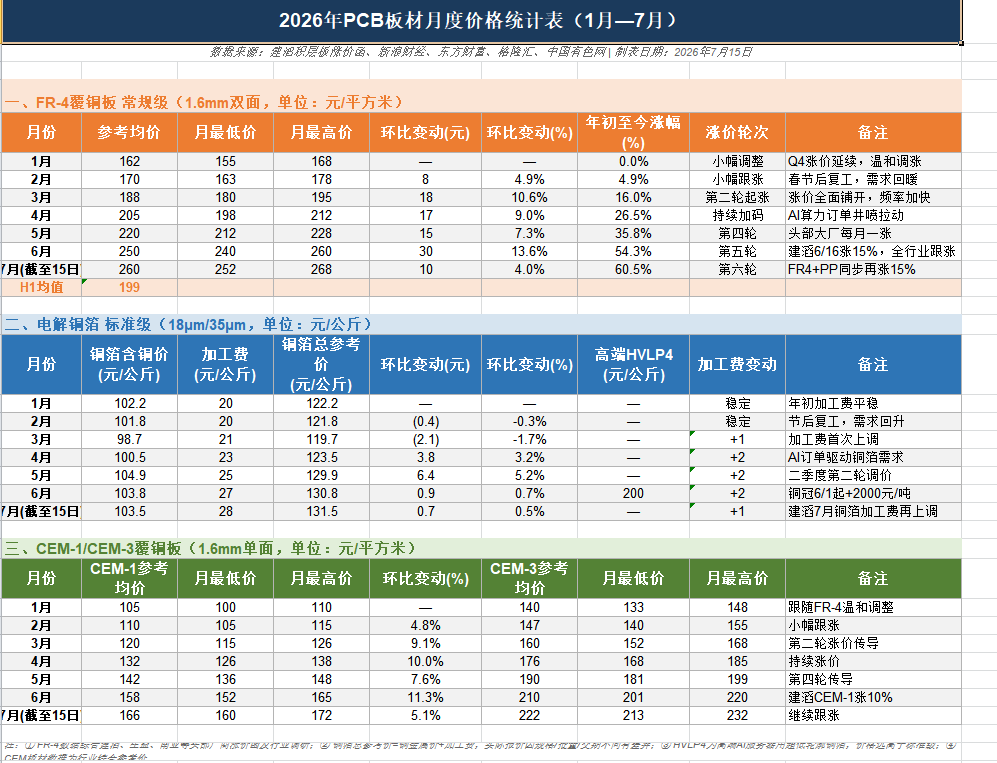
According to the industry data provided for January through July 2026, the reference price of standard 1.6 mm double-sided FR-4 increased from RMB 162/m² in January to RMB 260/m² by July 15.
That represents an increase of approximately 60.5% from the beginning of the year.
For companies purchasing large PCB quantities, even a relatively small material price movement can have a noticeable impact on total project cost.
Table of Contents
PCB Material Prices Have Increased Significantly in 2026
The clearest change can be seen in standard FR-4.
Standard FR-4 Reference Price Trend
| Month | Reference Price (RMB/m²) | Monthly Change |
|---|---|---|
| January | 162 | — |
| February | 170 | +4.9% |
| March | 188 | +10.6% |
| April | 205 | +9.0% |
| May | 220 | +7.3% |
| June | 250 | +13.6% |
| July* | 260 | +4.0% |
*July data is through July 15.
From January to July, the reference price increased by approximately 60.5%.
The first half-year average was around RMB 199/m², while July’s reference level had already reached RMB 260/m².
This does not mean every PCB uses material at these exact prices. Actual CCL pricing depends on:
- Material grade
- Brand
- Thickness
- Copper weight
- Order volume
- Specification
- Delivery requirements
- Supplier agreement
However, the direction of the market is important for buyers planning future production.
Copper Foil Prices Are Also Under Pressure
Copper foil is another important component of PCB material costs.
The reference data in the supplied market report shows the following trend for standard electrolytic copper foil:
| Month | Copper Foil Reference Price (RMB/kg) |
|---|---|
| January | 122.2 |
| February | 121.8 |
| March | 119.7 |
| April | 123.5 |
| May | 129.9 |
| June | 130.8 |
| July* | 131.5 |
*July data is through July 15.
Unlike FR-4, copper foil prices did not increase continuously every month. However, the total reference price moved from RMB 122.2/kg in January to RMB 131.5/kg in July.
That is approximately a 7.6% increase.
For standard PCB production, this may have a smaller direct impact than the CCL increase. For high-copper PCBs, heavy copper boards, and products requiring specialized copper foil, however, the effect can be more significant.
CEM Materials Have Also Become More Expensive
The increase is not limited to FR-4.
The supplied data shows that the reference price of CEM-1 increased from approximately RMB 105/m² in January to RMB 166/m² by July.
CEM-3 increased from approximately RMB 140/m² to RMB 222/m² during the same period.
| Material | January | July* | Approx. Increase |
|---|---|---|---|
| FR-4 | RMB 162/m² | RMB 260/m² | +60.5% |
| CEM-1 | RMB 105/m² | RMB 166/m² | +58.1% |
| CEM-3 | RMB 140/m² | RMB 222/m² | +58.6% |
*July figures are based on the supplied market data through July 15.
These figures should be treated as industry reference prices rather than fixed transaction prices.
The important point for buyers is that material inflation is affecting several PCB material categories at the same time.
Why Are PCB Materials Becoming More Expensive?
Several factors are contributing to the current market conditions.
AI and High-Speed Computing Demand
AI servers, high-speed switches, optical modules, and data-center infrastructure are consuming increasing quantities of advanced PCB materials.
High-performance applications often require materials with:
- Lower dielectric loss
- Controlled dielectric constant
- Low-profile copper
- High thermal stability
- High Tg
- Improved signal integrity
These materials cannot always be substituted directly with conventional FR-4.
As demand increases, supply for certain grades can become tighter.
Copper Foil Capacity Is Another Constraint
Copper foil is particularly important for high-speed and high-layer-count PCB production.
The supplied market analysis indicates that high-end low-profile copper foil capacity remains relatively limited compared with demand from advanced computing and networking applications.
This matters because the PCB industry cannot immediately add large amounts of specialized capacity. New production lines require substantial capital investment and qualification time.
Electronic Glass and Resin Costs
CCL is not simply copper foil and resin.
Electronic glass fiber and resin systems also affect laminate costs.
The supplied report indicates that the price of E-glass 7628 fabric increased from approximately RMB 5/m to RMB 8/m.
When multiple upstream materials increase simultaneously, CCL manufacturers face pressure to adjust their selling prices.
What Could Happen in the Second Half of 2026?
The supplied market forecast provides three possible scenarios.
| Scenario | Probability in Report | FR-4 Forecast Average | Copper Foil Forecast |
|---|---|---|---|
| Base / High Price | 50% | RMB 280–320/m² | RMB 130–145/kg |
| Accelerated Increase | 30% | RMB 320–400/m² | RMB 145–165/kg |
| High-Price Correction | 20% | RMB 230–280/m² | RMB 115–130/kg |
These are market scenarios, not guaranteed prices.
Under the report’s base scenario, FR-4 would remain at a relatively high level during the second half of 2026, with the strongest pressure expected around the traditional peak production period.
The report’s monthly base-case estimate is:
| Month | FR-4 Forecast Range |
|---|---|
| July | RMB 255–275/m² |
| August | RMB 265–290/m² |
| September | RMB 275–300/m² |
| October | RMB 285–310/m² |
| November | RMB 290–315/m² |
| December | RMB 285–310/m² |
For buyers, the important message is not that a particular number is guaranteed.
It is that waiting for a significant price reduction carries a real supply and cost risk.
Which PCB Projects Are Most Exposed to Material Price Changes?
Not every PCB project is affected equally.
High-Layer-Count PCBs
Boards with 12, 16, 18, 20, or more layers consume substantially more laminate and copper materials than simple two-layer boards.
For these projects, material cost can become a significant part of the overall PCB quotation.
Related Reading: 20 Layer PCB Manufacturing
High-Frequency PCBs
High-frequency and high-speed applications often require specialized laminates rather than standard FR-4.
Material substitution is therefore more difficult.
Related Reading: High Frequency PCB Material Selection
Heavy Copper PCBs
Boards using 3 oz, 4 oz, or higher copper weights have greater exposure to copper-related cost changes.
This is particularly relevant to:
- Power electronics
- EV systems
- Industrial power supplies
- Battery systems
Long-Term Production Projects
A project that is quoted today but does not enter production for several months can face a different material cost environment.
This is particularly important for customers with:
- Annual production contracts
- Large blanket orders
- Long qualification cycles
- Automotive projects
- Industrial equipment programs
Should You Buy PCB Materials in Advance?
There is no universal answer.
The right approach depends on forecast demand, material type, cash flow, and storage conditions.
However, when a project has predictable production demand, locking material availability earlier can reduce exposure to both price increases and supply shortages.
For example, customers with confirmed production schedules may consider securing materials for upcoming batches instead of purchasing all materials only when the next PCB order is released.
This is particularly useful for:
- High-layer-count PCBs
- High-Tg materials
- High-frequency laminates
- Special copper weights
- Non-standard thicknesses
TOPFAST Has Material Inventory Available for Selected Projects
Because material prices and lead times can change quickly, TOPFAST maintains inventory for selected PCB materials and production requirements.
For customers with upcoming PCB projects, we can check:
- Current material availability
- Material specification
- Available quantity
- Suitable alternatives
- Estimated production timing
If you already have a PCB design or an upcoming production schedule, contact us before placing the order to check whether the required material is currently available from stock.
This can be especially useful when the project uses a material that has a longer procurement cycle.
How to Reduce PCB Material Cost Risk
1. Confirm Your Material Requirements Early
Before requesting a quotation, determine:
- PCB layer count
- Finished thickness
- Copper weight
- Tg requirement
- Dk / Df requirements
- Surface finish
- Annual quantity
The more precise the material specification, the easier it is to evaluate available options.
2. Avoid Unnecessary Material Upgrades
Not every design needs a premium laminate.
For example, a conventional industrial controller may not require the same material as a high-speed networking board.
Material selection should be based on the actual electrical and thermal requirements.
Related Reading: PCB Stackup Design Guide
3. Consider Material Alternatives
For suitable applications, engineers can evaluate whether an alternative laminate can meet the same requirements.
However, substitution should not be based solely on price.
Check:
- Dk
- Df
- Tg
- CTE
- Thermal performance
- Reliability requirements
- Customer qualification requirements
A cheaper material that requires redesign or requalification may ultimately cost more.
4. Improve Panel Utilization
Material efficiency is also affected by PCB panelization.
Better nesting can reduce unused laminate area and lower material consumption.
Even a few percentage points of improvement can become meaningful for large production volumes.
5. Lock Materials for Confirmed Production
If production demand is already predictable, purchasing material ahead of the manufacturing schedule can reduce exposure to short-term market movements.
This does not mean every customer should build a large inventory.
Instead, the decision should be based on:
confirmed demand + material availability + expected lead time + storage cost.
How to Check PCB Material Availability Before Ordering
Step 1: Send Your PCB Files
Provide the Gerber files or existing PCB specifications.
Step 2: Confirm the Material
Tell us the required:
- Material brand
- Material grade
- Tg
- Thickness
- Copper weight
Step 3: Check Current Inventory
TOPFAST can check whether the required material is already available in stock or whether procurement is required.
Step 4: Compare Available Options
If the exact material is unavailable, suitable alternatives can be evaluated based on the electrical and mechanical requirements.
Step 5: Confirm Production Timing
Once material availability is confirmed, the production schedule can be planned accordingly.
Contact Us About Current PCB Material Stock
If you have PCB projects planned for the coming months, it is worth checking material availability before the next production batch.
Send us your Gerber files or material requirements and ask us to check current stock.
For projects using high-layer-count, high-frequency, High-Tg, or special copper configurations, early confirmation can help reduce procurement uncertainty.
TOPFAST can check available inventory and discuss suitable material options based on your PCB requirements.
FAQ
A: Yes. The market data provided for January through July 2026 shows significant increases in several PCB material categories. Standard 1.6 mm FR-4 reference pricing increased from RMB 162/m² in January to RMB 260/m² by July 15.
A: There is no certainty. The supplied market forecast presents both continued high-price and correction scenarios. However, the base scenario expects FR-4 prices to remain elevated during the second half of 2026.
A: FR-4, CEM materials, copper foil, and specialized high-frequency laminates are all experiencing different levels of cost pressure.
A: If you have confirmed production demand and use materials with longer procurement cycles, securing material availability in advance may be reasonable. The decision should also consider storage cost and cash flow.
A: For selected materials and projects, TOPFAST maintains inventory and can check current availability. Customers can send their PCB specifications or Gerber files to confirm whether the required material is available.
Conclusion
PCB material costs have become an important procurement consideration in 2026.
The market data through July shows a substantial increase in standard FR-4 reference pricing, while copper foil and CEM materials have also moved higher. At the same time, demand from AI computing, telecommunications, and high-speed electronics continues to put pressure on selected high-performance materials.
For PCB buyers, the practical response is not simply to purchase as much material as possible.
A better approach is to:
- Forecast confirmed production demand
- Verify material availability early
- Evaluate technically suitable alternatives
- Improve panel utilization
- Secure materials for predictable production
- Avoid unnecessary material upgrades
If you have an upcoming PCB project, contact TOPFAST with your Gerber files or material specifications to check current inventory and availability before placing the next production order.
 EN
EN  PT
PT  AR
AR  DE
DE  FR
FR  ES
ES