
It is common to send the same PCB design to several manufacturers and receive quotations that are noticeably different.
Sometimes the difference is small.
In other cases, one quotation can be significantly higher or lower than another.
The first reaction is often:
“Why is this PCB manufacturer more expensive?”
That question is not always useful.
A better question is:
“Are these quotations actually based on the same manufacturing requirements?”
Two quotations can appear to describe the same PCB while using different assumptions about:
- Material
- Stackup
- Copper weight
- Surface finish
- Board thickness
- Hole requirements
- Tolerances
- Testing
- Quantity
- Lead time
A meaningful price comparison therefore needs to start with the technical specification.
Table of Contents
The PCB Quotation Is More Than a Unit Price
A PCB quotation normally represents several different cost elements.
Depending on the project, these may include:
- Engineering preparation
- Material
- Fabrication
- Tooling
- Testing
- Surface treatment
- Packaging
- Shipping
Some quotations combine several of these items into one price.
Others separate them.
This makes it easy to compare the wrong numbers.
For example, one quotation may include electrical testing while another excludes it.
The second quotation may look cheaper until the missing items are added.

Material Can Explain a Large Price Difference
Material is one of the first things to check.
A quotation may specify:
Standard FR-4
while another uses:
High-Tg FR-4
These are not necessarily equivalent materials.
Other differences may involve:
- Tg
- Dk
- Df
- CTE
- Resin content
- Copper foil
- Core thickness
- Prepreg construction
For a basic control board, standard FR-4 may be completely appropriate.
For a high-temperature or high-speed application, a different material may be necessary.
The cheapest material should therefore not automatically be considered the best quotation.
Stackup Can Change the Price
A multilayer PCB cannot be fully described simply by saying:
“6 layer PCB”
Two six-layer boards can have different:
- Core structures
- Prepreg thicknesses
- Copper weights
- Dielectric thicknesses
- Impedance requirements
These differences affect both performance and manufacturing cost.
For high-speed designs, the stackup also affects impedance and signal return paths.
This is why quotations for multilayer PCBs should ideally be compared using the same stackup or equivalent electrical construction.
The relationship between layer arrangement and electrical performance is covered in PCB Stackup Design.
Copper Weight Is Often Overlooked
Copper weight can make a meaningful difference to cost.
A quotation based on:
1 oz copper
cannot be directly compared with one based on:
2 oz copper
even if every other specification is identical.
This becomes more important for power electronics and boards with high-current paths.
Check both:
- Outer-layer copper
- Inner-layer copper
because they may not be the same.
Surface Finish Can Affect the Quote
Surface finish is another common source of variation.
A quotation may use:
- HASL
- Lead-free HASL
- ENIG
- OSP
- Immersion silver
These processes have different costs and characteristics.
For example, ENIG is commonly selected for applications requiring a relatively flat surface, including some fine-pitch assembly designs.
If one quotation uses HASL and another uses ENIG, the price difference is partly explained by the surface finish.
Board Thickness Matters
Board thickness can also cause different quotations.
Common thicknesses are usually easier to produce.
Unusual constructions may require more specific material combinations or tighter control.
Check whether the quotations are based on the same:
- Nominal thickness
- Thickness tolerance
- Copper weight
- Stackup
A difference in any of these can affect the final price.
Drill Requirements Can Change the Cost
Hole structure is particularly important when comparing multilayer or HDI PCBs.
A conventional PCB may use standard mechanical through-holes.
A more complex design may require:
- Small mechanical holes
- Blind vias
- Buried vias
- Microvias
- Backdrilling
- Via-in-pad
These processes do not have the same manufacturing cost.
For example, an 8 layer PCB using standard through-hole vias is a very different manufacturing job from an 8 layer HDI PCB with stacked microvias.
See HDI PCB Cost for a more detailed look at how these structures affect PCB pricing.
Minimum Trace Width and Spacing
A quotation can also vary because of manufacturing geometry.
Compare:
- Minimum line width
- Minimum spacing
- Annular ring
- Solder mask clearance
- Drill-to-copper clearance
A design that requires very fine features can need tighter process control.
If one manufacturer calculates the job using its standard process and another prices it as a near-limit fabrication job, their quotations may be very different.
Quantity Changes the Economics
Quantity has a major impact on unit price.
Suppose a project is quoted for:
10 boards
and:
1,000 boards
The manufacturing process may be similar, but the fixed costs are distributed very differently.
Prototype orders need to absorb:
- Engineering preparation
- Setup
- Tooling
- Testing preparation
Production quantities distribute these costs over many more boards.
This is why comparing a prototype quotation against a volume quotation on a simple unit-price basis is misleading.
For prototype projects, see PCB Prototype Cost.
Lead Time Can Change the Price
Two quotations may use the same technical specification but have different production schedules.
For example:
Standard production
versus
Expedited production
A faster schedule may require production priority or special material coordination.
If delivery date is not critical, there may be little reason to pay extra for expedited production.
On the other hand, when a delayed PCB blocks a product launch or engineering test, the additional cost may be justified.
Testing Requirements Should Be Compared
Testing can be another hidden difference.
Depending on the application, PCB production may include:
- Electrical testing
- AOI
- X-ray inspection
- Impedance testing
- Dimensional inspection
- Reliability testing
A quotation that excludes a required test can appear cheaper.
This does not make it a better quotation.
The correct comparison is:
same technical requirements + same testing scope + same quantity + same delivery requirements
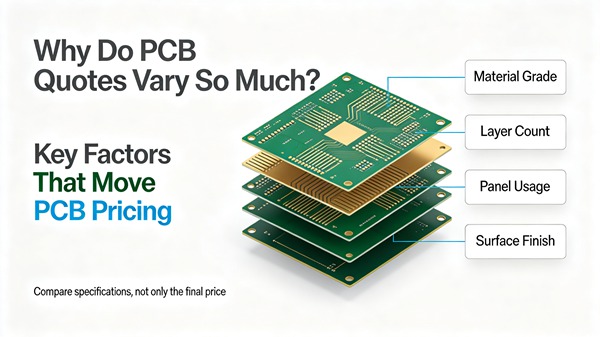
Why the Cheapest PCB Quote May Not Be the Cheapest Option
Imagine three quotations:
| Supplier | Initial Quote | Testing | Lead Time |
|---|---|---|---|
| A | $1,000 | Included | 12 days |
| B | $920 | Not included | 15 days |
| C | $1,080 | Included | 8 days |
At first glance, B appears to be the cheapest.
But if testing must be added and the longer lead time causes a production delay, the comparison changes.
This is why procurement decisions should consider total project cost, not only the initial PCB price.
How-To: Compare PCB Quotes Correctly
Step 1: Standardize the Technical Specification
Before requesting quotations, prepare a consistent specification covering:
- Layer count
- Board dimensions
- Material
- Thickness
- Copper weight
- Surface finish
- Minimum line width and spacing
- Minimum drill
- Via structure
- Impedance requirements
- Quantity
This makes the resulting quotations much easier to compare.
Step 2: Compare the Stackup
For multilayer PCBs, check whether the stackups are equivalent.
Pay particular attention to:
- Dielectric thickness
- Copper thickness
- Core construction
- Prepreg construction
If controlled impedance is required, the stackup becomes especially important.
Step 3: Check Special Processes
Look for differences in:
- HDI
- Microvias
- Via filling
- Backdrilling
- Heavy copper
- Special finishes
These can have a significant effect on price.
Step 4: Check Testing
Make sure every quotation includes the same testing requirements.
For example:
Electrical test included
should not be compared directly against:
Electrical test excluded
Step 5: Check Quantity and Delivery
Confirm:
- Exact quantity
- Prototype or production
- Standard or expedited lead time
- Delivery terms
These factors can materially affect the total project cost.
Step 6: Compare the Final Cost
The number that matters is not always the unit PCB price.
Consider:
PCB price + testing + tooling + shipping + rework risk + schedule impact
This gives a much more realistic comparison.
What Information Should Be Included in a PCB RFQ?
A good RFQ reduces unnecessary back-and-forth and makes quotations more comparable.
At minimum, provide:
Manufacturing Information
- Gerber files
- Drill files
- Board dimensions
- Quantity
- Layer count
Material Requirements
- Material family
- Tg if important
- Thickness
- Copper weight
Fabrication Requirements
- Surface finish
- Minimum drill
- Minimum line width/spacing
- Via structure
Electrical Requirements
- Controlled impedance
- Impedance values
- Required tolerances
Quality Requirements
- Inspection requirements
- Electrical testing
- Applicable standards
The more complete the RFQ, the less likely the quotation will be based on assumptions.
How to Find the Reason Behind a Large Price Difference
When one quote is much higher than the others, do not immediately assume the manufacturer is simply charging more.
Ask for the quotation assumptions.
Check:
- Is the material identical?
- Is the stackup equivalent?
- Is copper weight the same?
- Is surface finish the same?
- Are testing requirements included?
- Is the quantity identical?
- Is the lead time identical?
- Are special processes included?
- Are tolerances equivalent?
- Are shipping costs included?
In many cases, the difference becomes understandable after these items are standardized.
PCB Cost Should Be Compared at the Same Quality Level
Price comparison is only meaningful when the products being compared are equivalent.
For example:
Standard FR-4 + HASL + standard vias
and
High-Tg FR-4 + ENIG + HDI + controlled impedance
should not be treated as competing quotations for the same PCB simply because both are described as “4 layer” or “8 layer.”
The technical specification determines the manufacturing job.
When a Higher PCB Quote May Be Reasonable
A higher quotation can be justified when it includes something that reduces project risk.
Examples include:
- Better-specified materials
- Required testing
- Tighter process control
- More demanding HDI structures
- Faster delivery
- More appropriate reliability controls
The question should therefore be:
What additional value or requirement is represented by the price difference?
If there is no meaningful difference in specification or service, then the higher quotation deserves further explanation.
FAQ
A: The most common reasons are differences in material, stackup, copper weight, surface finish, via structure, testing, quantity, and lead time.
A: No. First confirm that all quotations are based on equivalent technical and quality requirements.
A: Yes. Fixed engineering and setup costs are distributed across the order quantity, so larger production runs generally have lower unit costs.
A: It may use a different material, omit testing, assume a different surface finish, exclude certain processes, or simply have different production assumptions. The quotation details should be checked before making a decision.
A: At minimum, compare material, stackup, layer count, thickness, copper weight, surface finish, via structure, testing, quantity, lead time, and total delivered cost.
Conclusion
A PCB quotation should never be evaluated by the unit price alone.
When quotations differ significantly, the first step is to identify what is actually different.
The most important items to compare are:
- Material
- Stackup
- Layer count
- Copper weight
- Board thickness
- Via structure
- Surface finish
- Tolerances
- Testing
- Quantity
- Lead time
Once these variables are standardized, the price difference becomes much easier to understand.
For engineers and purchasing teams, a good PCB quotation is not simply the lowest number. It is a quotation that accurately reflects the required manufacturing specification and gives a realistic picture of the final project cost.
For TOPFAST projects, providing the complete Gerber package together with the required technical specifications allows the quotation to be evaluated on the same basis as other offers, rather than relying on assumptions about the design.
 EN
EN  PT
PT  AR
AR  DE
DE  FR
FR  ES
ES