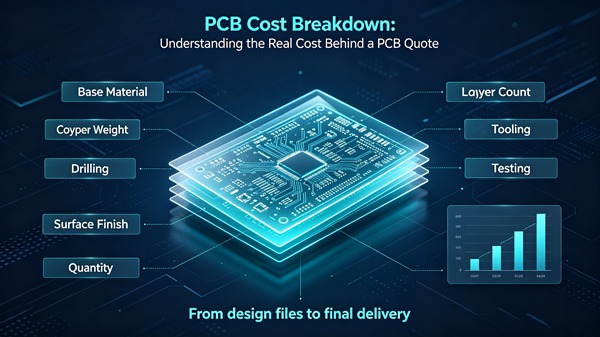
A PCB quotation can look surprisingly different from one supplier to another, even when the Gerber files are identical.
The reason is that PCB pricing is not based on a single manufacturing operation.
A typical PCB production cost may include:
- Raw materials
- Copper
- Inner-layer processing
- Lamination
- Drilling
- Plating
- Etching
- Surface finish
- Solder mask and silkscreen
- Testing
- Tooling and setup
- Quality inspection
- Packaging
Some specifications have a direct impact on material consumption, while others increase the number or difficulty of manufacturing processes.
Understanding these cost components makes it much easier to evaluate a quotation before placing an order.
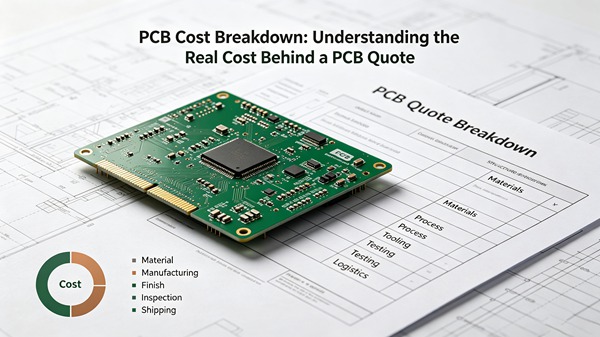
Table of Contents
What Is Included in PCB Cost?
At a high level, PCB cost can be divided into several categories:
| Cost Category | Typical Factors |
|---|---|
| Material | Laminate, copper, prepreg |
| Fabrication | Imaging, etching, lamination |
| Drilling | Hole quantity, size, type |
| Plating | Copper thickness, via structure |
| Surface finish | HASL, ENIG, OSP, etc. |
| Testing | Electrical testing, AOI, impedance |
| Engineering | CAM, DFM, tooling |
| Production | Quantity and manufacturing efficiency |
| Logistics | Packaging and shipping |
The exact proportion varies significantly depending on PCB structure.
A simple 2-layer board may be dominated by material and setup costs, while a complex HDI board can have much higher processing and engineering costs.
1. PCB Material Cost
Material is one of the most obvious components of PCB pricing.
The basic material structure includes:
- Copper foil
- Core
- Prepreg
- Resin
- Glass fiber
For standard boards, FR-4 is widely used.
More demanding applications may require:
- High-Tg FR-4
- Low-loss materials
- PTFE-based materials
- High-frequency laminates
- Metal-core materials
Material selection should follow the electrical and environmental requirements of the application.
Choosing a more expensive laminate without a technical reason adds cost without necessarily improving the finished product.
2. Copper Cost
Copper contributes directly to the material cost of a PCB.
Common copper weights include:
- 0.5 oz
- 1 oz
- 2 oz
- 3 oz
- 4 oz and above
Higher copper weight means more copper material and may also require more demanding etching and plating processes.
For power electronics, heavy copper can be necessary for:
- Higher current capacity
- Better heat dissipation
- Lower conductor resistance
Therefore, copper weight should be selected based on electrical requirements rather than simply choosing the lowest available specification.
3. Layer Count
Layer count has a major influence on manufacturing cost.
A multilayer PCB may require multiple:
- Inner-layer imaging operations
- Lamination cycles
- Drilling operations
- Plating stages
- Inspection steps
For example, an 8-layer board is not simply twice the manufacturing cost of a 4-layer board.
The relationship is affected by:
- Stackup
- Material construction
- Hole structure
- Production quantity
- Design complexity
Related: Multilayer PCB Manufacturing
4. Board Size and Panel Utilization
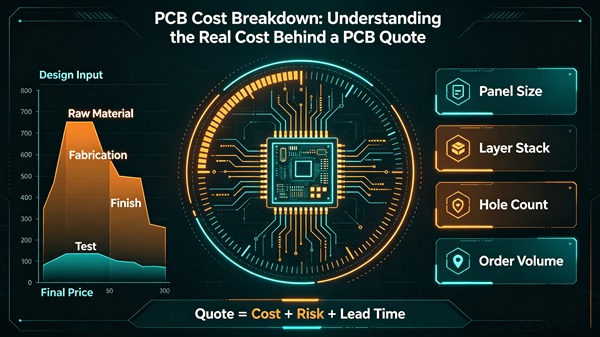
A larger PCB consumes more material.
But panel utilization is equally important.
Suppose a production panel can accommodate:
- 10 boards in one arrangement
but an alternative board dimension allows:
- 12 boards per panel
The second design may have a lower material cost per PCB even if the individual board dimensions are nearly identical.
This is why panelization should be considered before finalizing the mechanical dimensions.
Related: PCB Panelization Guidelines
5. Drilling Cost
Drilling is another major part of PCB fabrication.
Standard through-holes are relatively straightforward.
More complex requirements can increase cost:
- Small mechanical holes
- Large numbers of holes
- Blind vias
- Buried vias
- Microvias
- Backdrilling
Laser drilling and sequential structures require additional processing and equipment.
This is one reason why an HDI PCB can cost considerably more than a conventional multilayer PCB of similar size.
6. Plating Cost
After drilling, copper plating is used to establish electrical connections through the board.
Plating requirements depend on:
- Hole structure
- Copper thickness
- Aspect ratio
- Reliability requirements
Poor plating quality can lead to reliability problems such as via cracks and barrel failures.
Related: PCB Via Failure Analysis
For this reason, reducing plating requirements purely to lower cost is generally not a sensible strategy.
7. Surface Finish Cost
Surface finish affects both price and assembly performance.
Common options include:
- HASL
- Lead-free HASL
- ENIG
- OSP
- Immersion silver
- Immersion tin
HASL is often economical for conventional applications.
ENIG may be preferred when the design requires:
- Flat pads
- Fine-pitch components
- BGA assembly
- Improved surface uniformity
The correct finish depends on the assembly process and application rather than price alone.
8. Solder Mask and Silkscreen
Solder mask and silkscreen normally represent a smaller portion of total PCB cost.
However, unusual requirements can add processing complexity.
Examples include:
- Special solder mask colors
- Tight mask clearances
- Selective solder mask removal
- Complex marking requirements
For most standard designs, these costs are relatively minor compared with materials, layers, drilling, and surface finish.
9. Testing Cost
Testing requirements vary according to application and production stage.
Common inspection and testing methods include:
AOI
Automated optical inspection can identify manufacturing defects such as:
- Shorts
- Opens
- Etching problems
- Registration issues
Electrical Testing
Electrical testing verifies circuit continuity and isolation.
Impedance Testing
High-speed designs may require controlled impedance verification.
X-Ray Inspection
X-ray inspection is useful for inspecting internal structures and certain complex assemblies.
The more demanding the testing requirement, the greater the associated production cost.
10. Engineering and Tooling Costs
Not all PCB costs come directly from the physical board.
Before production, engineering teams may need to perform:
- Gerber analysis
- CAM preparation
- DFM review
- Tool generation
- Panelization
- Stackup verification
Some suppliers charge these costs separately, while others include them in the PCB quotation.
When comparing quotations, make sure these items are being compared on the same basis.
11. Production Quantity
Quantity has a major effect on unit price.
A small prototype order has fixed costs distributed over relatively few boards.
For example:
Engineering + tooling + setup = fixed cost ↓ divided by quantity ↓ unit cost decreases
As production quantity increases, manufacturing efficiency generally improves.
However, ordering more PCBs than necessary simply to obtain a lower unit price can increase inventory risk.
For new products, it is often more sensible to validate the design first and scale production afterward.
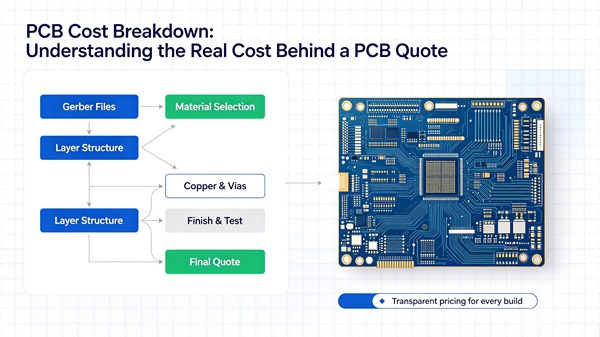
Why Two PCB Quotes Can Be Very Different
Consider a hypothetical 4-layer PCB.
Supplier A quotes a low price.
Supplier B quotes 30% more.
At first glance, Supplier A appears to be the better option.
But the quotation may contain different assumptions.
For example:
| Item | Quote A | Quote B |
|---|---|---|
| Material | Standard FR-4 | High-Tg FR-4 |
| Copper | 1 oz | 1 oz |
| Surface finish | HASL | ENIG |
| Testing | Electrical | Electrical + AOI |
| Tolerance | Standard | Tighter |
| Packaging | Standard | Moisture protection |
The two prices are not actually comparing identical manufacturing requirements.
This is why price comparison should always start with specification comparison.
How-To: Compare Two PCB Quotations Correctly
Step 1: Compare the Material
Check:
- Laminate type
- Tg
- Dk/Df if applicable
- Core and prepreg construction
Do not compare only the words “FR-4.”
Step 2: Compare Layer and Copper Structure
Confirm:
- Layer count
- Copper weight
- Internal copper
- External copper
Step 3: Compare Hole Requirements
Check:
- Minimum drill
- Through-hole count
- Blind vias
- Buried vias
- Microvias
- Backdrilling
Step 4: Compare Surface Finish
Make sure both quotations specify the same finish.
ENIG and HASL should not be treated as equivalent pricing options.
Step 5: Compare Testing
Ask whether the quoted price includes:
- Electrical test
- AOI
- Impedance test
- X-ray
- Reliability testing
Step 6: Compare Quantity and Lead Time
A low unit price may depend on a larger production quantity or longer lead time.
Step 7: Compare the Final Delivered Cost
Consider:
PCB price + tooling + testing + packaging + shipping
This provides a much more realistic comparison.
How to Reduce PCB Cost Without Reducing Reliability
Cost reduction should focus on eliminating unnecessary complexity rather than removing necessary quality controls.
Good cost-reduction opportunities
- Optimize layer count
- Use standard materials where appropriate
- Improve panel utilization
- Avoid unnecessarily tight tolerances
- Reduce unnecessary special processes
- Select a suitable surface finish
- Optimize production quantity
Poor cost-reduction strategies
- Reducing copper below electrical requirements
- Using unsuitable laminate
- Removing necessary testing
- Reducing plating below reliability requirements
- Selecting a process that cannot consistently meet the design
The second group may reduce the initial quotation but increase the total cost later.
When a More Expensive PCB Is Actually Cheaper
A higher PCB price can sometimes reduce total product cost.
For example, a more robust PCB may reduce:
- Assembly defects
- Field failures
- Rework
- Warranty claims
- Production downtime
This is particularly important in:
- Automotive electronics
- Industrial controls
- Medical equipment
- Power electronics
- High-reliability products
Therefore, engineers should consider total cost of ownership, rather than focusing only on the initial PCB unit price.
FAQ
A: PCB cost normally includes materials, fabrication, drilling, plating, surface finishing, testing, engineering, and production-related expenses.
A: Additional layers require more lamination, imaging, drilling, plating, and inspection processes.
A: Yes. Fixed engineering and setup costs are distributed across more boards at higher production volumes.
A: Different material specifications, surface finishes, testing requirements, tolerances, production quantities, and lead times can all change the quotation.
A: The most effective approach is to remove unnecessary manufacturing complexity while keeping the electrical, mechanical, and reliability requirements intact.
Conclusion
A PCB quotation represents much more than the cost of laminate and copper.
The final price is influenced by the entire manufacturing chain:
Material → Layer Structure → Drilling → Plating → Surface Finish → Testing → Production Volume
When comparing PCB quotations, engineers should first make sure the specifications are genuinely equivalent.
The best cost reduction strategy is not to choose the cheapest manufacturing option. It is to design and manufacture the PCB with only the complexity that the application actually requires.
That approach provides a better balance between price, manufacturability, reliability, and long-term product cost.
 EN
EN  PT
PT  AR
AR  DE
DE  FR
FR  ES
ES