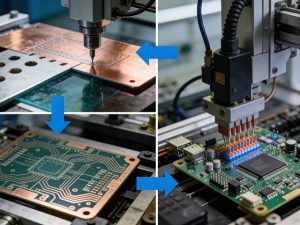
What Is the Difference Between PCB Assembly and Fabrication?
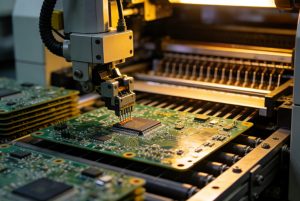
PCB manufacturing produces bare circuit boards, while PCB assembly (PCBA) involves soldering components onto the circuit board. There are key differences in terms of process,...
The typical delivery cycle for PCB assembly, from prototyping to mass production, is affected by manufacturing time, component supply, and design complexity.
Learn why PCB assembly costs are high and how to save money! Key factors such as component price increases, labor and craftsmanship, equipment setup, and...
1. Core Advantages of Copper as the Preferred PCB Material 1.1 Unmatched Electrical Performance 1.2 Exceptional Process Compatibility 1.3 Cost-Effectiveness Analysis 2. Engineering Value of...
Based on Topfast’s years of experience and big data research, 70% of manufacturing costs are determined during the design phase, while actual production costs (including...
PCB panelization is a critical step in improving production efficiency. This section provides a detailed explanation of the three panelization techniques—V-cut, stamp holes, and hollow...
Topfast offers fast turnaround PCB services, including ultra-short lead times (24 hours to 5 days), multi-layer board support (1 to 16 layers), advanced manufacturing processes,...
When it comes to PCB punching, it's key to keep an eye on measurements like diameter and spacing. We're comparing the benefits of punching technology...
The classification and differences between active and passive components in electronic circuits are explained in detail, along with the working principles and typical applications of...
PCB assembly is a critical step in electronics manufacturing, but it often encounters issues such as poor soldering, component damage, and short circuits/open circuits. By...
Comprehensive comparison of single-layer and double-layer PCBs in terms of structure, performance, and application scenarios, providing professional selection recommendations. At the same time, we introduce...
Introduces the design and installation of PCB positioning holes, analyzes the technical details of pin and socket connections, provides professional solutions to five common connection...
Microvia technology forms tiny connections of less than 150 microns on PCBs through advanced processes such as laser drilling, which significantly improves wiring density and...
Eighteen-layer PCB key technology-microvia design, including the definition of microvia technology, core advantages and the application value in complex multilayer boards, the three common problems...
Microvia technology for 14-layer printed circuit boards, from laser drilling specifications to solving plating defects and signal reflection problems, we offer viable solutions backed by...
What is PCB layout, and its importance? If you want to ensure the reliability of PCB products, you must first do the following three things...
Topfast's complete production process of four-layer PCB boards from design to finished product, including precision stacked layer design, high-precision inner layer production, lamination process control...
An in-depth analysis of how surface mount technology (SMT) has become the industry standard for electronics manufacturing, detailing its significant advantages in terms of space...