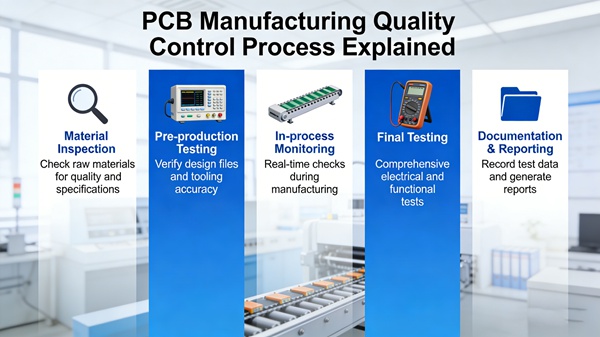
PCB fabrication is a multi-step process involving chemical treatment, thermal lamination, mechanical drilling, and plating.
Each step introduces potential variation.
Quality control is not a single inspection at the end of production.
It is a structured system applied throughout the entire manufacturing process.
This article explains how PCB quality control works in real production environments and why it directly affects reliability and assembly yield.
Table of Contents
Why Quality Control Is Critical in PCB Fabrication
Without structured inspection, even small process deviations can result in:
- Open circuits
- Short circuits
- Via reliability issues
- Layer misalignment
- Surface finish problems
These are commonly discussed in PCB manufacturing defects
Quality control exists to detect and prevent these issues before shipment.
Quality Control Throughout the PCB Manufacturing Process
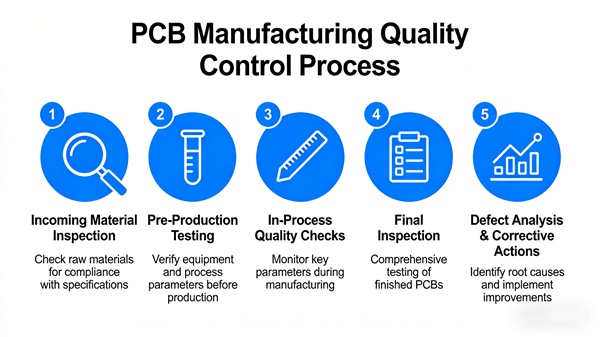
Quality control is applied at multiple stages of the PCB manufacturing process
It typically includes:
- Incoming material inspection
- In-process inspection
- Final electrical testing
- Reliability validation
Each stage targets different risk factors.
1. Incoming Material Inspection
Before fabrication begins, raw materials are inspected:
- Copper-clad laminate thickness
- Prepreg condition
- Copper foil integrity
- Surface finish chemicals
Material variation directly impacts impedance, lamination stability, and long-term reliability.
2. Inner Layer Inspection (AOI)
After imaging and etching inner layers, Automated Optical Inspection (AOI) is used.
AOI detects:
- Opens
- Shorts
- Under-etching
- Over-etching
Detecting defects at this stage prevents costly scrap later in lamination.
3. Lamination Control and Registration Inspection
During multilayer lamination:
- Temperature
- Pressure
- Alignment accuracy
must be tightly controlled.
Misregistration can affect impedance and signal performance, especially in high-speed designs.
How PCB Manufacturing Process Affects Signal Integrity
4. Drilling and Via Inspection
After drilling:
- Hole wall quality is checked
- Drill accuracy is verified
- Debris removal is confirmed
Improper drilling can lead to plating voids or weak via structures.
Via reliability is one of the most critical long-term performance factors.
5. Plating Thickness Measurement
Copper plating thickness affects:
- Current carrying capacity
- Via reliability
- Mechanical strength
Thickness is measured using cross-section analysis or X-ray fluorescence testing.
Insufficient plating often leads to intermittent failures in the field.
6. Solder Mask Inspection
Solder mask alignment is verified to prevent:
- Exposed copper
- Solder bridging
- Pad contamination
Poor solder mask control reduces assembly yield.
7. Electrical Testing
Electrical testing confirms circuit continuity.
Common methods:
- Flying probe testing (prototypes / small volume)
- Fixture testing (large volume)
This step verifies that no opens or shorts remain after fabrication.
8. Final Visual and Dimensional Inspection
Before shipment, final inspection checks:
- Board outline accuracy
- Surface finish quality
- Warpage
- Cosmetic condition
Dimensional tolerance is verified against design requirements.
See: PCB Manufacturing Tolerances Explained
IPC Standards and Quality Levels
Most professional manufacturers follow IPC standards:
- IPC Class 2 (standard industrial)
- IPC Class 3 (high reliability)
Higher IPC classes require stricter inspection and documentation.
Inspection level directly affects the cost and reliability balance.
See: PCB Manufacturing Cost Breakdown
How Quality Control Impacts PCB Assembly
Fabrication quality directly affects:
- Solder joint reliability
- BGA yield
- Reflow stability
- Field failure rates
Stable fabrication processes reduce assembly defects and improve long-term performance.
Quality control is not only about passing inspection—it protects downstream manufacturing.
Conclusion
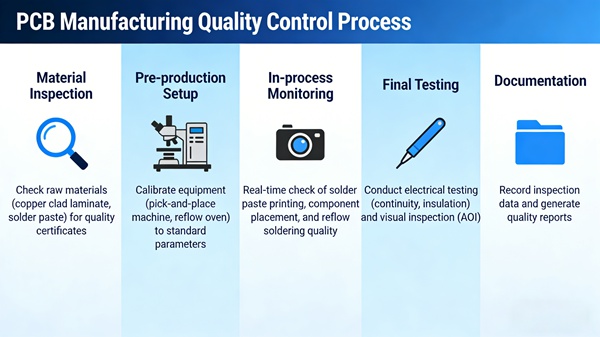
PCB manufacturing quality control is a structured, multi-stage system applied from raw material to final inspection.
Reliable boards are the result of:
- Controlled processes
- Early defect detection
- Realistic tolerances
- Appropriate inspection levels
Understanding how quality control works allows engineers and purchasing teams to evaluate suppliers more effectively and reduce long-term risk.
Frequently Asked Questions (FAQ)
A: Electrical testing is critical because it verifies circuit continuity. However, early-stage inspections such as AOI prevent defects from progressing into later processes.
A: Yes. Additional inspection steps require equipment time and labor. However, insufficient inspection may increase field failure risk, which is far more costly.
A: IPC Class 2 is for general industrial applications. IPC Class 3 applies to high-reliability products such as aerospace or medical devices and requires tighter acceptance criteria.
A: For most professional production, yes. Prototypes and production boards are typically electrically tested to ensure no opens or shorts remain.
A: Review their inspection stages, IPC compliance level, testing methods, and ability to provide inspection reports or cross-section data.
 EN
EN  PT
PT  AR
AR  DE
DE  FR
FR  ES
ES