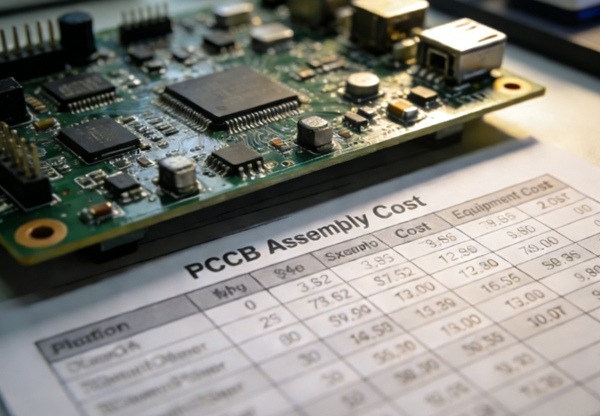
Understanding PCB assembly cost is essential for budgeting, supplier selection, and product planning. Many customers focus only on the unit price, but the PCBA cost is influenced by multiple technical and production factors.
In this guide, TOPFAST, a professional PCB manufacturer, explains how PCB assembly costs are calculated, what affects pricing, and how to reduce PCBA costs without sacrificing quality.
Table of Contents
What Is Included in PCB Assembly Cost?
PCB assembly cost typically includes:
- Bare PCB fabrication
- Component sourcing
- SMT & THT assembly labor
- Soldering processes
- Inspection and testing
- Engineering and setup costs
Process overview:
PCB Assembly Process Explained
Key Factors That Affect PCB Assembly Cost
1. PCB Specifications
PCB-related factors include:
- Number of layers
- Board size and thickness
- Material type (FR4, Rogers, Aluminum)
- Surface finish (HASL, ENIG, OSP)
More complex PCBs cost more to manufacture and assemble.
Related article:
PCB Manufacturing vs PCB Assembly
2. Component Cost
Components often represent 50–70% of the total PCBA cost.
Factors include:
- Component type and package
- Availability and lead time
- Brand and manufacturer
- Obsolete or end-of-life parts
Accurate BOMs help control sourcing costs.
Related guide:
PCB Assembly File Requirements Explained
3. Assembly Method (SMT vs THT)
- SMT assembly is more automated and cost-effective
- THT assembly requires more manual labor
- Mixed assembly increases complexity
Related article:
SMT vs THT PCB Assembly: Key Differences Explained
4. Quantity and Order Volume
- Prototype and low-volume orders have a higher unit cost
- Mass production significantly reduces per-unit cost
- Setup and engineering costs are spread across volume
5. Testing Requirements
Testing affects both cost and reliability.
Common testing options:
- AOI inspection
- X-ray inspection
- ICT
- Functional testing (FCT)
More testing increases cost but reduces failure risk.
Related article:
PCBA Testing Methods Explained
6. Turnkey vs Consigned Assembly
- Turnkey PCBA includes component sourcing
- Consigned PCBA uses customer-supplied components
Turnkey assembly often reduces hidden costs and delays.
Related guide:
What Is Turnkey PCB Assembly and How It Works
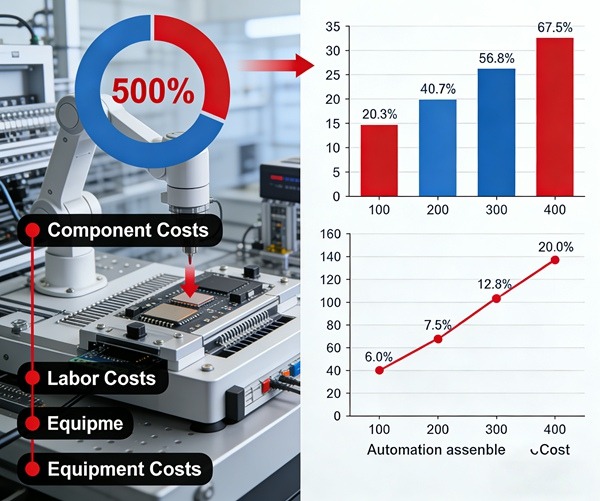
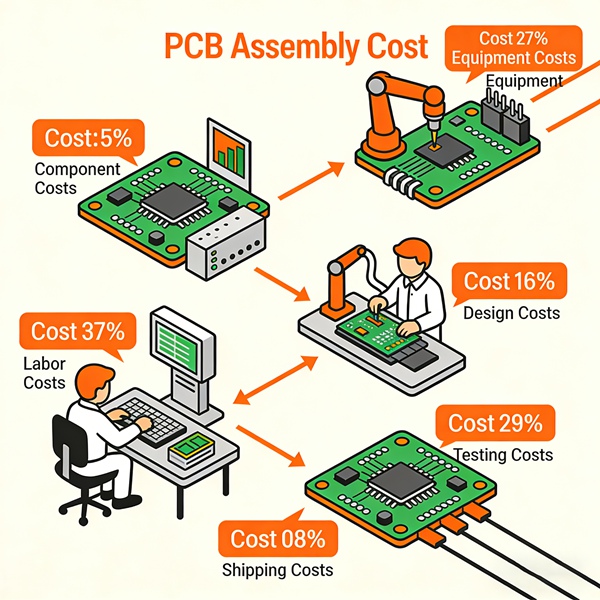
Typical PCB Assembly Cost Breakdown
| Cost Item | Percentage |
|---|---|
| Components | 50–70% |
| PCB fabrication | 10–20% |
| Assembly labor | 10–15% |
| Testing & QC | 5–10% |
| Engineering & setup | 3–8% |
Actual costs vary based on project complexity.
How to Reduce PCB Assembly Cost
Optimize Your Design
- Reduce layer count where possible
- Standardize component packages
- Avoid unnecessary tight tolerances
Improve File Accuracy
- Provide complete Gerber, BOM, and CPL files
- Include alternative components
- Add clear assembly notes
File guide:
PCB Assembly File Requirements Explained
Choose the Right Assembly Method
- Use SMT wherever possible
- Limit THT to the necessary components
Order in Higher Volumes
- Combine prototype batches
- Plan production runs strategically
Work with an Experienced Manufacturer
An experienced partner like TOPFAST can:
- Optimize DFM/DFA
- Suggest cost-saving alternatives
- Prevent costly production errors
Service page:
PCB Assembly Services – Complete Turnkey PCBA Solutions
PCB Assembly Cost vs Long-Term Reliability
Lower cost does not always mean better value. Poor assembly quality leads to:
- Higher failure rates
- Increased warranty claims
- Costly recalls
Balanced cost and quality result in better long-term performance.
Industries with Cost-Sensitive PCBA
- Consumer electronics
- IoT devices
- Industrial controllers
- Automotive electronics
Each industry balances cost, reliability, and compliance differently.
Why Choose TOPFAST for Cost-Effective PCB Assembly?
As a professional PCB manufacturer, TOPFAST offers:
- Transparent pricing
- Competitive component sourcing
- Flexible production volumes
- Strict quality control
- Engineering support to reduce cost
TOPFAST helps customers achieve the best balance between cost and quality.
PCB Assembly Cost FAQ
A: Setup and engineering costs are not spread across large volumes.
A: Often no. It reduces sourcing errors and delays.
A: Yes. Alternative components can significantly lower the cost.
A: Yes. Testing reduces field failures and long-term expenses.
 EN
EN  PT
PT  AR
AR  DE
DE  FR
FR  ES
ES