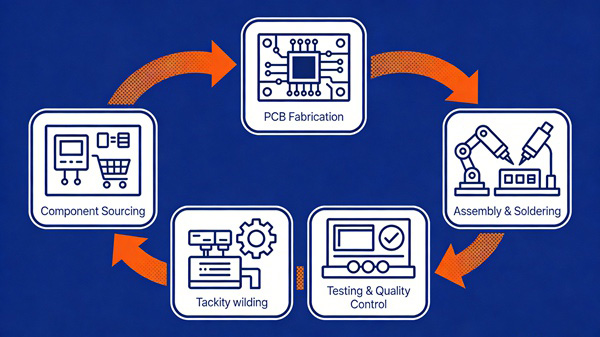
Turnkey PCB assembly has become the preferred solution for companies looking to simplify electronics manufacturing. Instead of managing multiple suppliers, turnkey PCBA offers a one-stop solution from PCB fabrication to final assembly and testing.
In this guide, TOPFAST, a professional PCB manufacturer, explains what turnkey PCB assembly is, how it works, its advantages and disadvantages, and when it is the right choice for your project.
Table of Contents
What Is Turnkey PCB Assembly?
Turnkey PCB assembly is a service model where a single manufacturer manages the entire PCBA process, including:
- PCB manufacturing
- Component sourcing and procurement
- SMT & THT assembly
- Inspection and testing
- Final delivery
The customer only needs to provide design files, while the manufacturer delivers a fully assembled and tested PCBA.
Start with the basics:
What Is PCB Assembly? SMT, THT, and PCBA Explained
What Does “Turnkey” Mean in PCBA?
In manufacturing, “turnkey” means a solution that is ready to use immediately—you simply “turn the key.”
In PCBA, this means:
- No need to source components separately
- No coordination between PCB and assembly vendors
- One point of responsibility for quality and delivery
This approach significantly reduces management complexity, especially for overseas customers and startups.
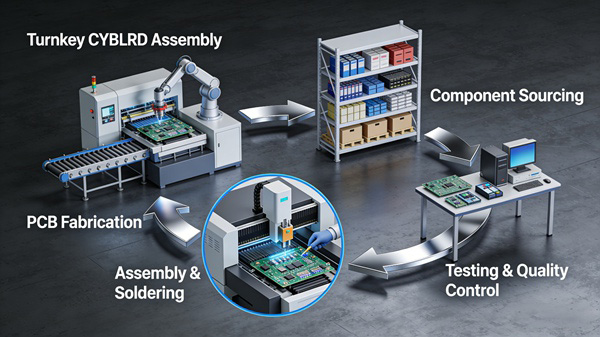
Turnkey PCB Assembly Process
A standard turnkey PCB assembly process includes the following steps:
1. File Submission & Engineering Review
Customers submit:
- Gerber files
- BOM (Bill of Materials)
- Pick-and-Place (CPL) files
Engineers perform DFM/DFA checks to ensure manufacturability.
Related guide:
PCB Assembly File Requirements Explained
2. PCB Fabrication
- Bare PCB manufacturing based on design requirements
- Electrical testing to ensure board integrity
Related article:
PCB Manufacturing vs PCB Assembly
3. Component Sourcing
- Components sourced from authorized suppliers
- Alternatives recommended for obsolete or long-lead items
- Incoming quality inspection (IQC)
This step is a major advantage of turnkey PCBA.
4. PCB Assembly (SMT & THT)
- Solder paste printing
- Automated SMT placement
- THT insertion (if required)
- Reflow and wave soldering
Related article:
PCB Assembly Process Explained
5. Inspection & Testing
- AOI inspection
- X-ray inspection for BGA and fine-pitch parts
- Functional testing (if required)
Related article:
PCBA Testing Methods Explained
6. Final QC & Delivery
- Visual inspection
- Packaging
- Global shipping
Turnkey PCB Assembly vs Consigned PCB Assembly
| Aspect | Turnkey PCBA | Consigned PCBA |
|---|---|---|
| PCB supply | Manufacturer | Customer |
| Components | Manufacturer | Customer |
| Management effort | Low | High |
| Risk | Lower | Higher |
| Lead time | Shorter | Longer |
Cost comparison:
PCB Assembly Cost Explained
For most projects, turnkey PCB assembly provides better efficiency and predictability.
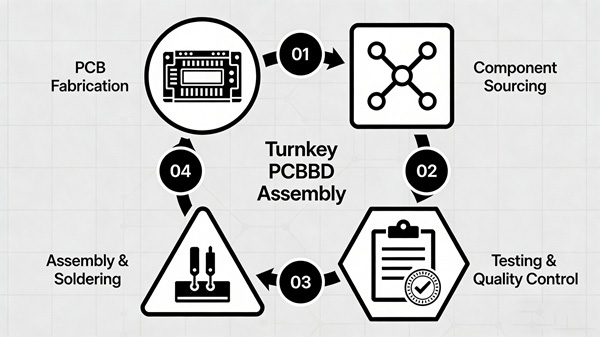
Advantages of Turnkey PCB Assembly
- One-stop solution
- Reduced procurement risk
- Shorter lead time
- Better DFM/DFA optimization
- Clear responsibility for quality
These benefits make turnkey PCBA ideal for prototypes, startups, and global customers.
Potential Limitations of Turnkey PCBA
- Less control over specific component brands
- Not ideal for customer-owned or special components
In such cases, a partial turnkey or consigned model may be more suitable.
When Should You Choose Turnkey PCB Assembly?
Turnkey PCBA is recommended if you:
- Want to reduce supplier coordination
- Need fast prototype turnaround
- Lack of in-house sourcing resources
- Are you ordering from overseas
Explore services:
PCB Assembly Services – Complete Turnkey PCBA Solutions
Why Choose TOPFAST for Turnkey PCB Assembly?
As a professional PCB manufacturer, TOPFAST offers reliable turnkey PCB assembly services with:
- Integrated PCB manufacturing and assembly
- Experienced engineering support
- Strict quality control
- Flexible order quantities
- Competitive pricing
TOPFAST helps customers move from design to production efficiently and safely.
Turnkey PCB Assembly FAQ
A: Gerber files, BOM, Pick-and-Place files, and assembly notes.
A: Not necessarily. It often reduces hidden costs related to sourcing errors and delays.
A: Yes. Partial turnkey options are available.
A: Consumer electronics, industrial control, automotive, medical, IoT, and telecom.
Final Thoughts
Turnkey PCB assembly simplifies electronics manufacturing by providing a single, reliable partner for the entire PCBA process.
By choosing TOPFAST, customers benefit from professional manufacturing expertise, efficient assembly workflows, and consistent quality from prototype to production.
Get started with TOPFAST turnkey PCB assembly services today.
 EN
EN  PT
PT  AR
AR  DE
DE  FR
FR  ES
ES