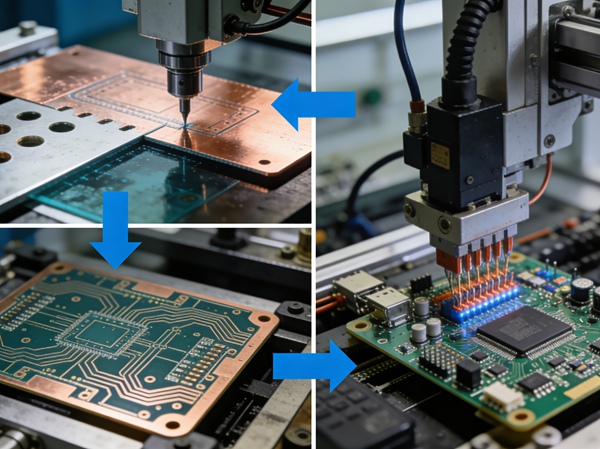
PCB manufacturing and PCB assembly are two closely related but fundamentally different stages in electronics production. Many customers use these terms interchangeably, which often leads to confusion, delays, or unexpected costs.
In this guide, TOPFAST, a professional PCB manufacturer, explains the differences between PCB manufacturing and PCB assembly, how each process works, and how they fit together in a complete PCBA solution.
Table of Contents
What Is PCB Manufacturing?
PCB manufacturing is the process of producing the bare printed circuit board without any electronic components installed.
Typical PCB manufacturing steps include:
- Material selection (FR4, Rogers, Aluminum, etc.)
- Inner layer imaging and etching
- Lamination and pressing
- Drilling and via formation
- Copper plating
- Solder mask and silkscreen
- Electrical testing
The result of PCB manufacturing is an unassembled PCB, ready for component mounting.
Related guide:
PCB Manufacturing Process Explained
What Is PCB Assembly?
PCB assembly (PCBA) is the process of mounting electronic components onto a manufactured PCB to create a functional electronic circuit.
PCB assembly typically includes:
- Solder paste printing
- Component placement (SMT / THT)
- Reflow or wave soldering
- Inspection and functional testing
Unlike PCB manufacturing, PCB assembly directly determines whether a product works reliably in real-world applications.
👉 Related article:
PCB Assembly Services – Complete Turnkey PCBA Solutions

Key Differences Between PCB Manufacturing and PCB Assembly
| Aspect | PCB Manufacturing | PCB Assembly |
|---|---|---|
| Output | Bare PCB | Fully assembled PCBA |
| Components | Not included | Installed |
| Main focus | Board structure & materials | Functionality & reliability |
| Key files | Gerber, stack-up | BOM, Pick & Place, Gerber |
| Quality risks | Short circuits, impedance | Solder defects, placement errors |
This distinction is essential when requesting quotations or planning project timelines.
How PCB Manufacturing and PCB Assembly Work Together
In real projects, PCB manufacturing and PCB assembly are sequential and interdependent.
- PCB design is completed
- PCB manufacturing produces the bare board
- PCB assembly installs components
- Inspection and testing validate performance
Errors in PCB manufacturing can cause assembly issues, while poor assembly can waste perfectly manufactured boards.
This is why many customers choose a one-stop PCB manufacturing and assembly service.
See also:
PCB Assembly Process Explained: Step-by-Step PCBA Guide
Cost Differences: Manufacturing vs Assembly
PCB Manufacturing Cost Factors
- Board size and layer count
- Material type
- Impedance control
- Surface finish
- Quantity
PCB Assembly Cost Factors
- Number of components
- SMT vs THT ratio
- Fine-pitch or BGA parts
- Testing requirements
- Order volume
👉 Cost breakdown:
PCB Assembly Cost Explained
Understanding which stage drives cost helps optimize your total PCBA budget.
Lead Time Differences
- PCB Manufacturing:
- Prototype: 24–72 hours
- Production: 5–15 working days
- PCB Assembly:
- Prototype: 3–7 working days
- Production: 1–4 weeks
When handled by separate suppliers, coordination issues often extend the total lead time.
👉 Related guide:
PCB Assembly Lead Time: Prototype vs Mass Production
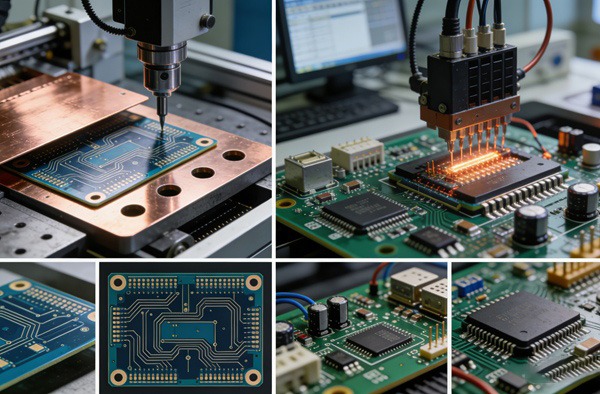
PCB Manufacturing + Assembly: One-Stop vs Separate Suppliers
Separate Suppliers
- More vendor coordination
- Higher communication risk
- Potential mismatch in specifications
One-Stop PCBA Service
- Single point of responsibility
- Better DFM/DFA optimization
- Shorter overall lead time
As a professional PCB manufacturer, TOPFAST provides integrated PCB manufacturing and assembly services to simplify project management and improve reliability.
Which Service Do You Actually Need?
You may need:
- Only PCB manufacturing
If you already have in-house assembly capability - Only PCB assembly
If you supply your own bare boards - Complete PCBA (recommended)
For most projects, especially prototypes and overseas customers
Start here:
What Is PCB Assembly? SMT, THT, and PCBA Explained
PCB Manufacturing vs PCB Assembly FAQ
A: Not always. Some suppliers only offer assembly. Turnkey PCBA includes both.
A: Yes, but it may increase coordination risk and lead time.
A: Both are critical. Manufacturing affects board integrity, while assembly affects functionality.
A: Manufacturing mainly requires Gerber files, while assembly also needs BOM and Pick-and-Place files.
👉 Detailed list:
PCB Assembly File Requirements Explained
Final Thoughts
PCB manufacturing and PCB assembly serve different purposes, but must work seamlessly together for successful electronics production.
By choosing an experienced partner like TOPFAST, customers benefit from integrated manufacturing expertise, efficient assembly processes, and consistent quality from prototype to production.
👉 Explore services:
PCB Assembly Services – Complete Turnkey PCBA Solutions
 EN
EN  PT
PT  AR
AR  DE
DE  FR
FR  ES
ES