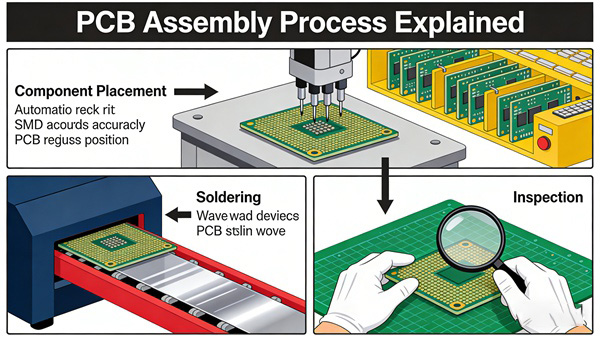
Understanding the PCB assembly process is essential for ensuring product quality, reducing cost, and shortening lead time. At TOPFAST, a professional PCB manufacturer, we provide turnkey PCB assembly services that cover every step from prototyping to mass production.
This article walks you through the step-by-step PCB assembly process, explains the differences between SMT and THT, and highlights key quality control measures.
Table of Contents
Step 1: File Review & DFM/DFA Check
Before assembly begins, TOPFAST engineers review all submitted design files.
Key steps:
- Verify Gerber files for accuracy
- Check BOM (Bill of Materials) completeness
- Validate Pick-and-Place (CPL) files
- Perform DFM (Design for Manufacturing) and DFA (Design for Assembly) analysis
Why it matters: Early detection of design errors prevents assembly defects and rework.
👉 Related article: PCB Assembly File Requirements Explained
Step 2: PCB Fabrication
Once the files are verified, the bare PCB is fabricated.
Process includes:
- Material selection (FR4, Rogers, Aluminum, etc.)
- Inner layer imaging and etching
- Lamination and drilling
- Copper plating, solder mask, and silkscreen
- Electrical testing
A high-quality PCB provides the foundation for successful assembly.
Related article: PCB Manufacturing vs PCB Assembly
Step 3: Solder Paste Printing
For SMT assembly, solder paste is applied to the pads using a stencil.
Details:
- Uniform paste thickness is critical
- Reduces solder defects
- Prepares the board for component placement
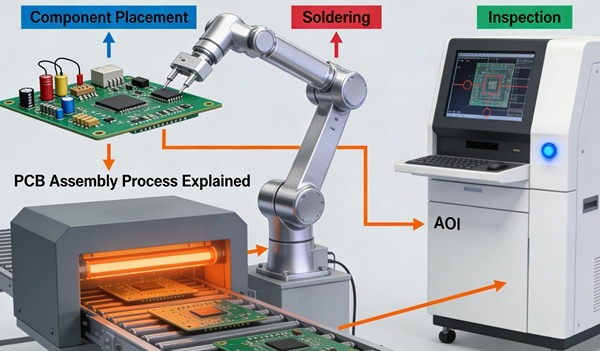
Step 4: Component Placement (SMT & THT)
SMT (Surface Mount Technology)
- Components placed by automated pick-and-place machines
- Suitable for fine-pitch components like BGA, QFN, LGA
- High speed and accuracy
THT (Through-Hole Technology)
- Components are manually or semi-automatically inserted through holes
- Ideal for connectors, transformers, and high-mechanical-stress parts
Mixed assembly combines SMT and THT for complex designs.
Related article: SMT vs THT PCB Assembly
Step 6: Inspection & Testing
Quality control is critical. TOPFAST uses multiple inspection methods:
- Automated Optical Inspection (AOI) – checks solder joints and placement
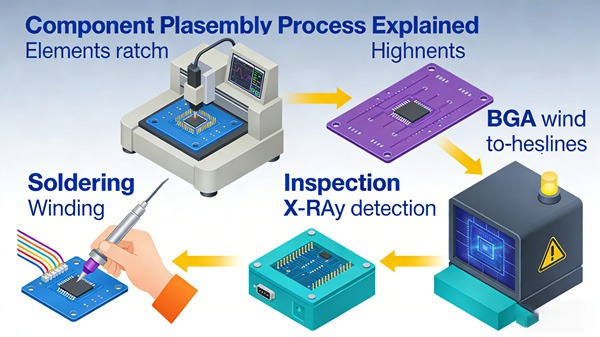
- X-Ray Inspection – for hidden solder joints (BGA, fine pitch)
- Functional Testing (FCT) – ensures circuits work as intended
Why it matters: Reduces defects, ensures product reliability.
👉 Related article: PCBA Testing Methods Explained
Step 7: Final QC & Packaging
- Visual inspection of each board
- Functional verification
- Safe packaging for shipment
- Global delivery for prototyping or production orders
TOPFAST ensures every PCB assembly meets high-quality standards before delivery.
Common PCB Assembly Challenges
- Misalignment of components
- Solder bridging or cold joints
- Defective or missing components
- Poor solder paste application
Solution: Early DFM/DFA checks, automated assembly, thorough inspection.
Cost & Lead Time Considerations
PCB assembly cost depends on:
- Number and type of components
- SMT vs THT ratio
- Testing requirements
- Order volume
Typical lead times:
- Prototype: 3–7 days
- Small batch: 7–14 days
- Mass production: 2–4 weeks
👉 Related article: PCB Assembly Cost Explained
Industries Using PCB Assembly
- Consumer electronics
- Industrial automation
- Automotive electronics
- Medical devices
- Telecommunications
- IoT and smart devices
TOPFAST tailors assembly processes to meet each industry’s quality and reliability standards.
Why TOPFAST PCB Assembly?
- Turnkey PCB assembly from prototype to mass production
- Strict quality control (AOI, X-ray, functional testing)
- Experienced engineers for DFM/DFA review
- Fast delivery and competitive pricing
Choosing TOPFAST ensures reliable and efficient PCB assembly every time.
PCB Assembly FAQ
A: SMT components are surface-mounted using automated machines; THT components are inserted through holes.
A: Yes. Mixed assembly is common for complex designs.
A: Provide Gerber, BOM, and Pick-and-Place files.
👉 Read more: PCB Assembly File Requirements Explained
A: Prototype: 3–7 days; Production: 1–4 weeks, depending on order size.
 EN
EN  PT
PT  AR
AR  DE
DE  FR
FR  ES
ES