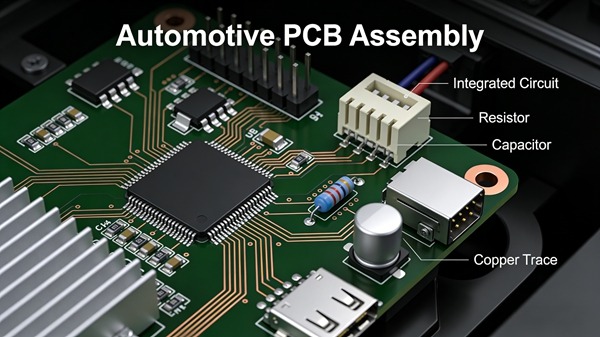
Automotive PCB assembly is one of the most demanding sectors in electronics manufacturing.
Electronics used in vehicles must operate reliably under extreme temperature, vibration, and long service life requirements.
In this guide, TOPFAST, a professional PCB manufacturer, explains automotive PCB assembly standards, manufacturing processes, testing requirements, and best practices for high-reliability automotive PCBA.
Table of Contents
What Is Automotive PCB Assembly?
Automotive PCB assembly refers to PCB assembly services designed specifically for vehicle electronics, including safety-critical and performance-critical systems.
Compared to standard PCB assembly, automotive PCBA requires:
- Stricter quality management
- Longer lifecycle support
- Advanced testing and traceability
Industry overview:
Industry-Specific PCB Assembly
Automotive PCB Assembly Standards
IATF 16949
IATF 16949 is the primary quality management standard for automotive manufacturing.
It emphasizes:
- Defect prevention
- Process control
- Continuous improvement
- Traceability and documentation
Automotive PCBA suppliers are often required to comply with IATF 16949.
IPC Standards
Common IPC standards in automotive PCBA:
- IPC-A-610 Class 3
- IPC-6012 (for PCB fabrication quality)
Typical Applications of Automotive PCB Assembly
Automotive PCBA is used in:
- ADAS systems
- Engine control units (ECU)
- Battery management systems (BMS)
- Infotainment systems
- Body control modules
Reliability and safety are top priorities.
Automotive PCB Assembly Process
1. Design Review & Reliability Analysis
Focus areas include:
- Thermal stress
- Mechanical vibration
- Signal integrity
- Failure mode analysis
Design preparation:
PCB Assembly File Requirements Explained
2. PCB Fabrication for Automotive Use
Automotive PCBs often require:
- High-Tg materials
- Thick copper
- Controlled impedance
- Automotive-grade surface finishes
Fabrication context:
PCB Manufacturing vs PCB Assembly
3. Automotive-Grade Component Sourcing
Key requirements:
- AEC-Q qualified components
- Long-term supply assurance
- Approved alternative components
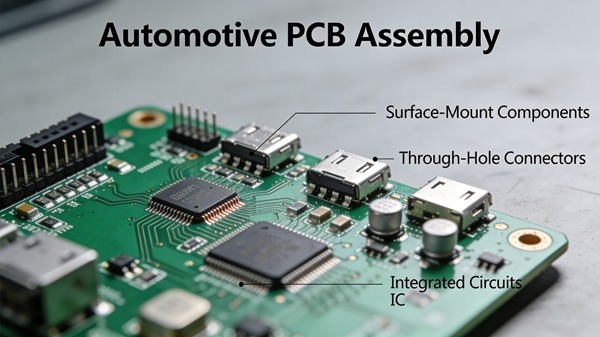
4. SMT & THT Assembly
Assembly features include:
- Precision SMT placement
- Robust solder joints
- THT for power and connector components
- Strict ESD and process control
Assembly techniques:
SMT vs THT PCB Assembly
5. Inspection & Testing
Automotive PCBA testing typically includes:
- AOI inspection
- X-ray inspection (BGA, QFN)
- Functional testing
- Environmental stress testing (optional)
Testing overview:
PCBA Testing Methods Explained
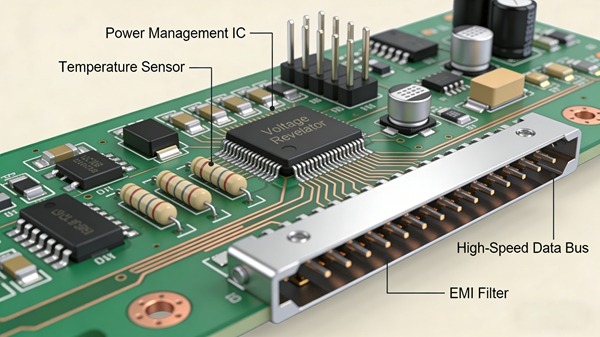
Automotive PCB Assembly Volume Models
Automotive PCBA often involves:
- Prototype PCB assembly
- Low volume PCB assembly (NPI phase)
- Mass production
Production stages:
Automotive PCB Assembly Lead Time
Typical lead times:
- Prototype / NPI: 7–15 working days
- Production: 3–6 weeks
Component availability and testing scope affect delivery.
Timing reference:
PCB Assembly Lead Time Explained
Automotive PCB Assembly Cost Factors
Cost is influenced by:
- Automotive-grade components
- Testing and validation
- Documentation and traceability
- Production volume
Cost reference:
PCB Assembly Cost Explained
Common Challenges in Automotive PCB Assembly
- Long qualification cycles
- Component lifecycle management
- High reliability expectations
- Strict change control
Experienced suppliers reduce qualification risk.
Best Practices for Automotive PCB Assembly
- Design with automotive-grade components
- Engage manufacturers early (DFM/DFA)
- Plan component supply long-term
- Validate testing strategies early
Service model:
What Is Turnkey PCB Assembly and How It Works
Why Choose TOPFAST for Automotive PCB Assembly?
As a professional PCB manufacturer, TOPFAST provides:
- Automotive-focused PCBA solutions
- Advanced SMT & THT assembly
- Strong component sourcing capabilities
- Comprehensive inspection and testing
- Support from prototype to production
TOPFAST understands that automotive electronics leave no room for compromise.
Conclusion
Automotive PCB assembly demands the highest levels of reliability, quality management, and process control.
From automotive-grade components and robust assembly processes to comprehensive testing and documentation, every detail is critical to vehicle safety and performance.
By partnering with TOPFAST, a professional PCB manufacturer, customers gain a trusted automotive PCBA partner capable of supporting prototype, NPI, and production automotive PCB assembly, ensuring long-term reliability and compliance throughout the product lifecycle.
Automotive PCB Assembly FAQ
A: Often yes, especially for Tier 1 and Tier 2 suppliers.
A: Yes, due to components, testing, and compliance requirements.
A: Yes. Prototyping is essential for validation and qualification.
A: Yes, with proper planning and qualified processes.
 EN
EN  PT
PT  AR
AR  DE
DE  FR
FR  ES
ES