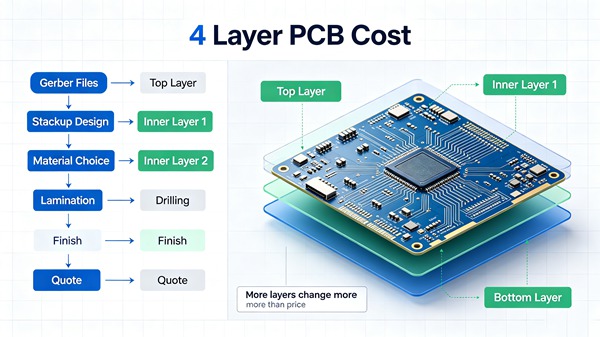
PCB material is one of the main factors affecting printed circuit board manufacturing cost. Although many standard boards use FR-4, not every application can rely on the same laminate. High-speed circuits, RF products, power electronics, automotive systems, and high-temperature equipment may require materials with different electrical, thermal, or mechanical properties.
These differences influence more than the price of the raw laminate. Material selection can also affect drilling, lamination, processing parameters, manufacturing yield, and the availability of suitable production materials.
For purchasing teams, the challenge is to choose a material that meets the product’s technical requirements without paying for properties the design does not need.
This article examines how common PCB materials affect manufacturing cost, why specialty laminates are generally more expensive, and what engineers should consider when comparing material options.
Table des matières
Why PCB Material Affects Manufacturing Cost
A PCB laminate is not simply a base sheet used to support copper circuits. It forms the insulating structure of the board and influences electrical performance, thermal behavior, mechanical strength, and manufacturing stability.
Different materials have different compositions, resin systems, glass reinforcement, dielectric properties, and processing requirements.
Several factors contribute to the final material-related cost.
Raw laminate price
The most direct cost difference comes from the laminate itself.
Standard FR-4 is widely available and produced in large volumes. Its established supply chain makes it a common choice for general-purpose PCB manufacturing.
Specialty materials, including low-loss RF laminates and high-temperature materials, may have higher raw material prices because of their formulation, performance characteristics, and more limited production volumes.
The exact cost depends on the material manufacturer, product series, thickness, copper cladding, and availability.
Material processing requirements
Not all laminates behave the same way during PCB fabrication.
Differences in resin systems, glass reinforcement, thermal properties, and mechanical characteristics can affect:
- Drilling and hole-wall quality
- Copper-to-resin bonding
- Lamination conditions
- Stabilité dimensionnelle
- Desmear and surface treatment
- Routing and edge quality
Some specialty materials require specific process parameters or additional manufacturing controls. These requirements can increase production cost even when the raw material price is not the only major difference.
Disponibilité des matériaux
Material availability is another practical cost factor.
Standard FR-4 products are generally easier to source than specialized high-frequency laminates or unusual dielectric constructions.
If a project requires a specific manufacturer, material series, thickness, or copper configuration, procurement may take longer. Limited availability can also affect production scheduling and quotation validity.
For urgent prototype orders, the availability of the exact requested laminate can be just as important as its unit price.
Finished board performance requirements
The selected material must support the actual electrical and environmental conditions of the product.
For example, a high-speed communication board may require controlled dielectric properties and low signal loss. A power electronics board may need better thermal management. An industrial controller may require suitable thermal stability and long-term mechanical reliability.
Selecting a material with unnecessary performance capabilities can increase cost without improving the finished product in a meaningful way.
PCB Material Cost Comparison
The following table summarizes common PCB material categories and their typical cost characteristics.
| Matériau du circuit imprimé | Relative Material Cost | Applications courantes | Main Cost Consideration |
|---|---|---|---|
| FR-4 standard | Low | General electronics | Widely available and established processing |
| High Tg FR-4 | Low to medium | Industrial and high-temperature applications | Higher thermal performance requirements |
| High-speed FR-4 | Moyen | Circuits numériques à grande vitesse | Controlled dielectric and loss properties |
| Stratifiés Rogers | Medium to high | Circuits RF et hyperfréquences | Specialty dielectric materials |
| PTFE-based laminates | Haut | Applications haute fréquence | Specialized processing and material handling |
| Circuit imprimé à base d'aluminium | Medium to high | LED and power electronics | Metal base and thermal construction |
| Polyimide | Medium to high | Flexible and rigid-flex circuits | Flexible material structure and processing |
| Ceramic-based materials | Haut | Specialized power and high-frequency applications | Material cost and specialized fabrication |
These are general comparisons, not fixed price rankings. Different product series within the same material category can have significantly different costs.
A specific Rogers laminate, for example, may have a different price and processing profile from another Rogers series. Board thickness, copper weight, quantity, and availability also affect the quotation.
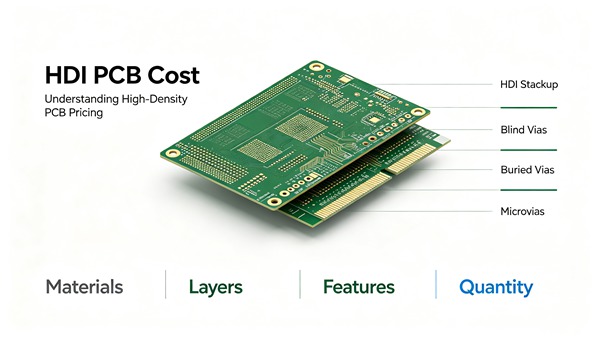
FR-4 PCB Cost and Why It Remains the Standard Choice
FR-4 is the most widely used PCB substrate for general electronic applications.
It is a glass-reinforced epoxy laminate with a long-established manufacturing supply chain. Its combination of electrical insulation, mechanical strength, and reasonable thermal performance makes it suitable for a broad range of products.
Why standard FR-4 is relatively economical
Standard FR-4 benefits from large-scale production and broad material availability.
Manufacturers are familiar with its drilling, imaging, lamination, plating, and routing behavior. This established process knowledge helps keep fabrication predictable.
FR-4 is commonly used in:
- Electronique grand public
- Cartes de commande industrielles
- Alimentations électriques
- Systèmes embarqués
- General communication equipment
- Automotive electronic modules, where the specified material grade is suitable
For many conventional circuits, standard FR-4 provides sufficient performance without requiring a more expensive laminate.
When standard FR-4 may not be suitable
FR-4 is not a single material with identical properties across all grades.
Different FR-4 products have different glass transition temperatures, dielectric constants, dissipation factors, thermal expansion characteristics, and decomposition temperatures.
A standard low-cost FR-4 grade may not be suitable for every high-temperature or high-speed application.
Engineers should review the actual material datasheet rather than assuming that all FR-4 laminates offer the same performance.
High Tg FR-4 PCB Cost
High Tg FR-4 is designed for applications that require improved thermal stability compared with conventional FR-4 grades.
Tg, or glass transition temperature, describes the temperature range at which the resin system changes from a relatively rigid state to a softer, more flexible state.
It is an important material characteristic, but it should not be confused with the maximum continuous operating temperature of a PCB.
Why high Tg FR-4 may cost more
High Tg materials generally use resin systems designed to provide higher thermal stability.
Depending on the material series, this can result in a higher laminate price than standard FR-4.
The material selection may also be related to manufacturing requirements such as lead-free assembly compatibility, repeated thermal exposure, and dimensional stability.
High Tg FR-4 is commonly considered for:
- Équipement de contrôle industriel
- Électronique automobile
- Boards exposed to repeated thermal cycles
- Multilayer PCBs with demanding lamination requirements
- Products using lead-free soldering processes
Is high Tg FR-4 always necessary?
No. A higher Tg value does not automatically make a PCB more reliable in every application.
The correct choice depends on assembly temperature, operating conditions, board thickness, copper structure, thermal cycling, and the overall reliability requirements.
Using a high Tg material without a clear technical reason can increase material cost without providing a meaningful benefit.
High-Speed FR-4 Material Cost
Some high-speed PCB applications can use specially formulated FR-4 materials with improved dielectric properties and lower signal loss.
These materials are often positioned between standard FR-4 and more specialized RF laminates.
What makes high-speed FR-4 different?
High-speed FR-4 materials may offer:
- More controlled dielectric constant
- Lower dissipation factor
- Improved electrical consistency
- Better suitability for high-speed signal transmission
- More predictable impedance performance
The exact characteristics vary by material manufacturer and product series.
These properties can be important for high-speed digital circuits, networking equipment, computing hardware, and other applications where signal loss and timing performance matter.
How high-speed material affects PCB price
High-speed FR-4 may cost more than general-purpose FR-4 because of its material formulation and electrical performance specifications.
The cost difference also depends on the required laminate thickness, copper configuration, and whether the design uses a mixed-material construction.
When comparing quotations, specify the exact material series rather than using only a general description such as high-speed FR-4.
Rogers PCB Material Cost
Rogers is a well-known supplier of specialty laminates used in RF, microwave, and high-frequency applications.
Rogers materials are not all identical. Different product families are designed for different electrical, thermal, and mechanical requirements.
Examples include materials based on hydrocarbon ceramic systems and PTFE-based constructions.
Why Rogers PCB materials are more expensive
Compared with standard FR-4, many Rogers laminates have higher material costs due to their specialized dielectric properties and material composition.
Some product series are designed to provide:
- Low dielectric loss
- Stable dielectric constant
- Consistent high-frequency performance
- Controlled electrical characteristics
- Suitable thermal and mechanical behavior for RF applications
These properties can be important in antenna systems, RF modules, microwave circuits, radar equipment, and high-frequency communication products.
Rogers material processing considerations
Material cost is only one part of the manufacturing difference.
Some Rogers materials have different drilling, bonding, and surface preparation requirements from standard FR-4.
For example, PTFE-based laminates may require specialized processing because of their mechanical and bonding characteristics.
When a design combines Rogers and FR-4, the manufacturer must also consider the compatibility of the materials during lamination and the overall stackup construction.
This can increase manufacturing complexity compared with a conventional FR-4 board.
When is Rogers worth the additional cost?
Rogers should be considered when the electrical requirements justify its properties.
For a circuit operating at relatively low frequencies, standard FR-4 may be sufficient. For demanding RF or microwave applications, the lower dielectric loss and more stable electrical characteristics of a suitable Rogers material may be necessary.
The material should be selected based on the actual operating frequency, insertion loss budget, impedance requirements, and system performance targets.
PTFE PCB Material Cost
PTFE-based laminates are used in demanding high-frequency applications where low dielectric loss is important.
PTFE materials have different physical and processing characteristics from conventional epoxy-based FR-4.
Why PTFE laminates are costly
PTFE-based materials can involve higher raw material costs and more specialized fabrication processes.
Manufacturers may need to control drilling, surface preparation, bonding, and dimensional stability carefully.
The cost can also increase when the design requires hybrid construction with other laminate materials.
PTFE laminates are often used in:
- Circuits hyperfréquences
- RF antennas
- High-frequency communication equipment
- Systèmes radar
- Specialized aerospace and instrumentation electronics
What should be specified when ordering PTFE PCBs?
A quotation should identify the exact material series and thickness.
It should also include copper weight, finished board thickness, layer count, via requirements, surface finish, and any special bonding or hybrid stackup requirements.
A general request for a PTFE PCB may not provide enough information for an accurate quotation.
Aluminum-Based PCB Material Cost
Aluminum-based PCBs are commonly used in applications where heat dissipation is an important design requirement.
Unlike conventional FR-4 boards, an aluminum PCB typically consists of a copper circuit layer, a dielectric insulation layer, and an aluminum base.
What contributes to aluminum PCB cost?
The cost depends on several construction details:
- Aluminum base thickness
- Aluminum alloy and grade
- Dielectric material and thickness
- Épaisseur de la feuille de cuivre
- Dimensions de la planche
- Thermal conductivity requirements
- Surface finish and fabrication tolerances
A higher-performance dielectric layer or thicker aluminum base may increase the material cost.
Common applications
Aluminum PCBs are often used in LED lighting, power modules, automotive lighting, and other products where thermal management is important.
They are not simply a cheaper alternative to a multilayer FR-4 board. Their construction and electrical design requirements are different.
Before selecting an aluminum PCB, engineers should evaluate thermal resistance, insulation performance, electrical clearance, and mechanical requirements.
Polyimide Material Cost for Flexible and Rigid-Flex PCBs
Polyimide is widely used in flexible printed circuit boards because of its flexibility and thermal properties.
Flexible PCBs require different material structures from standard rigid boards.
A typical flexible circuit may include polyimide film, copper foil, adhesive or adhesive-less bonding structures, coverlay, and stiffeners where needed.
Why flexible PCB materials cost more
The cost is influenced by the type and thickness of polyimide film, copper construction, adhesive system, coverlay, and reinforcement requirements.
Flexible PCB fabrication also involves processes such as coverlay lamination, precision cutting, and handling of thin materials.
Rigid-flex designs add further complexity because rigid and flexible sections must be integrated into one structure.
When to use polyimide
Polyimide is suitable for applications requiring repeated or limited flexing, compact interconnections, or high-temperature performance.
Common applications include medical devices, cameras, automotive electronics, portable products, and compact industrial equipment.
For flexible and rigid-flex projects, material selection should be considered together with bend radius, dynamic flexing requirements, copper type, and layer construction.
How PCB Material Selection Interacts With Layer Count and Board Thickness
Material cost should not be evaluated separately from the rest of the PCB construction.
The selected laminate affects how the board is built, and the number of layers and finished thickness determine how materials are combined.
Material selection for multilayer PCBs
A multilayer PCB may use different core and prepreg materials to achieve its required stackup.
When specialty laminates are used, the manufacturer must confirm that the materials are compatible with the lamination process.
Hybrid constructions combining FR-4 with high-frequency materials can be useful when only certain circuit sections require low-loss characteristics.
However, hybrid construction can introduce additional engineering and manufacturing requirements.
The cost of a multilayer board therefore depends on both layer count and material selection.
For more detail, see PCB Layer Count Cost: How the Number of Layers Affects PCB Price.
Finished thickness and dielectric construction
The finished thickness of a PCB is determined by the copper layers, cores, prepregs, and other construction details.
Different laminate materials may be available in different standard thicknesses.
If a design requires an unusual thickness or a specific dielectric spacing, the manufacturer may need to use a less common material combination.
This can affect material availability and production cost.
Material properties and impedance requirements
The dielectric constant and dissipation factor of the laminate influence signal propagation and loss.
For controlled impedance designs, the material properties must be considered together with trace width, copper thickness, dielectric spacing, and the selected stackup.
Changing the material can require adjustments to the PCB layout.
For projects with strict impedance requirements, the material and stackup should be confirmed before final routing. More information is available in Controlled Impedance PCB Cost: What Increases the Price?.
How to Reduce PCB Material Cost Without Compromising Performance
Reducing material cost does not mean choosing the cheapest available laminate.
The objective is to use a material that meets the actual electrical, thermal, mechanical, and reliability requirements of the product.
Avoid specifying unnecessarily expensive materials
Start by reviewing the operating conditions of the product.
If a circuit does not require low-loss high-frequency performance, a specialty RF laminate may not provide a useful advantage.
Similarly, if the product does not experience demanding thermal conditions, a more expensive high Tg material may not be necessary.
Material specifications should be based on measurable design requirements.
Use specialty laminates only where needed
Some designs benefit from a hybrid stackup.
For example, a board may use a specialty high-frequency material for selected layers and FR-4 for other layers.
This can reduce the amount of expensive laminate required.
However, hybrid construction must be reviewed for lamination compatibility, dielectric properties, thermal expansion, and manufacturing capability.
Confirm standard material thicknesses
Unusual laminate thicknesses may have longer procurement times or higher costs.
Where electrical and mechanical requirements allow, selecting commonly available material thicknesses can make procurement and production more straightforward.
Optimize the stackup before fabrication
The stackup should be finalized before the board enters production.
Late changes to material grade, dielectric thickness, or copper construction may require layout adjustments and a new quotation.
A manufacturing review during the design stage can help identify material choices that are unnecessarily expensive or difficult to source.
Consider the total project cost
A lower-priced laminate is not always the most economical option.
If a material causes poor manufacturing yield, additional testing, or reliability issues, the resulting costs may exceed the initial material savings.
Compare the complete manufacturing and product requirements rather than evaluating the laminate price in isolation.
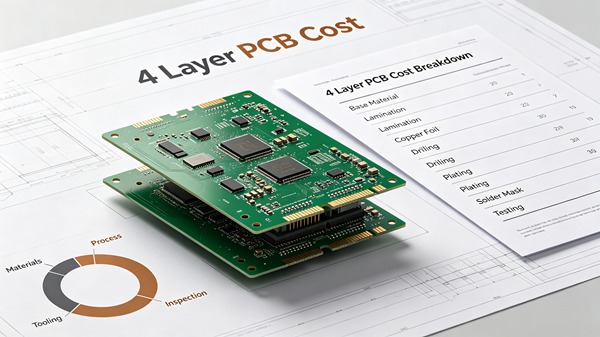
What Information Should Be Included in a PCB Material Cost Quotation?
To receive an accurate quotation, the material requirements should be clearly defined.
The following information is useful when submitting a PCB manufacturing inquiry.
| Information | Why It Matters |
|---|---|
| Material manufacturer and series | Identifies the exact laminate |
| Type de matériau | Defines FR-4, Rogers, PTFE, aluminum, polyimide, or other construction |
| Épaisseur diélectrique | Affects electrical performance and stackup |
| Finished board thickness | Determines the overall material construction |
| Poids du cuivre | Influences material and copper processing |
| Nombre de couches | Defines the multilayer structure |
| Dimensions de la planche | Affects material usage and panel utilization |
| Finition de la surface | Determines the final surface treatment |
| Via la structure | Affects drilling and interconnection processes |
| Exigences en matière d'impédance | May affect material and stackup selection |
| Quantité produite | Influences material purchasing and unit cost |
| Special requirements | Covers thermal, mechanical, and reliability specifications |
If the material has not yet been selected, provide the operating frequency, temperature range, electrical requirements, and application details.
A PCB manufacturer can then assess whether a standard laminate is suitable or whether a specialty material is necessary.
Common Mistakes When Comparing PCB Material Prices
Comparing only the material name
FR-4 and Rogers are broad material categories. Each includes different product series with different properties and prices.
A quotation comparison should identify the actual manufacturer and material series whenever possible.
Treating all FR-4 materials as identical
Different FR-4 grades can have different Tg values, dielectric properties, and thermal performance.
A low-cost FR-4 grade may not meet the requirements of a design that specifies a particular high-performance laminate.
Ignoring processing requirements
Some materials require more specialized drilling, lamination, or bonding processes.
A lower raw material price does not necessarily result in a lower finished PCB cost.
Changing materials without checking electrical performance
Replacing a laminate can change dielectric constant, loss characteristics, and impedance behavior.
Even if the replacement material is physically similar, the electrical design may need to be reviewed.
Omitting the exact material specification from the RFQ
A quotation based only on a general material description may use a manufacturer’s standard alternative.
If the project requires a specific material series, state this clearly in the fabrication notes and quotation request.
Frequently Asked Questions About PCB Material Cost
Which PCB material is the cheapest?
Standard FR-4 is generally one of the most economical and widely available PCB materials.
Its established manufacturing supply chain makes it suitable for many general-purpose electronic products.
However, the final PCB price also depends on board dimensions, layer count, copper weight, thickness, drilling, and production quantity.
Why are Rogers PCBs more expensive than FR-4 PCBs?
Many Rogers laminates are designed for specialized electrical performance, including low dielectric loss and controlled dielectric properties at high frequencies.
Their raw material cost can be higher, and some product series require more specialized processing.
The actual price difference depends on the selected material series and PCB construction.
Is high Tg FR-4 more expensive than standard FR-4?
High Tg FR-4 can have a higher material cost because it uses a resin system designed for improved thermal stability.
The difference varies by manufacturer and product series.
It should be selected when the assembly process, operating environment, or reliability requirements justify it.
Can I replace Rogers with FR-4 to reduce PCB cost?
Only if the electrical requirements allow it.
FR-4 and Rogers materials can have different dielectric constants and loss characteristics. Replacing one with the other may affect impedance, insertion loss, and high-frequency performance.
The change should be evaluated through electrical design analysis rather than based only on material price.
Does PCB material affect manufacturing lead time?
Yes. Standard FR-4 is generally easier to source, while specialty laminates may have limited availability.
A specific material series, thickness, or copper configuration may require additional procurement time.
Confirming material availability before placing an order can help prevent schedule changes.
Does a higher Tg value always mean a better PCB?
No. Tg is only one material property.
The appropriate laminate should also be evaluated for decomposition temperature, coefficient of thermal expansion, dielectric properties, moisture behavior, and the intended operating environment.
A higher Tg value alone does not guarantee better overall PCB performance.
Can one PCB use both FR-4 and Rogers materials?
Yes. Hybrid PCB construction can combine FR-4 with specialty high-frequency laminates.
This approach is sometimes used when only selected layers require low-loss electrical performance.
However, material compatibility, lamination conditions, thermal expansion, and stackup design must be considered during fabrication planning.
Conclusion
PCB material cost depends on more than the price of the raw laminate. Material availability, processing requirements, dielectric performance, thermal properties, and the overall PCB construction all influence the final manufacturing quotation.
Standard FR-4 remains a practical choice for many general-purpose applications. High Tg and high-speed FR-4 are useful when additional thermal or electrical performance is required, while Rogers and PTFE-based laminates are commonly selected for demanding RF and microwave designs. Aluminum-based and polyimide materials serve different thermal and flexible circuit requirements.
The most cost-effective material is not necessarily the cheapest one. It is the material that meets the product’s actual performance requirements while remaining practical to manufacture.
Before requesting a PCB quotation, confirm the material series, thickness, copper weight, layer count, and other construction details. If the material selection is still open, provide the design requirements so the manufacturing team can evaluate suitable options.
TOPFAST can review PCB fabrication files and material specifications to help assess manufacturing cost and construction feasibility. Submit your design through the PCB quotation page for a project-specific quotation.
 FR
 EN
 PT
 AR
 DE
 ES