
PCB lead time is an important part of the manufacturing quotation. Two orders with identical Gerber files, materials, and quantities may receive different prices if their required delivery dates are different.
A standard production schedule allows the manufacturer to arrange materials, combine compatible production orders, and use normal equipment capacity. An urgent order may require priority scheduling, faster material procurement, additional shifts, or changes to the production plan.
These adjustments can increase manufacturing cost, but not every short lead time requires the same level of extra expense.
For engineers and purchasing teams, understanding how delivery time affects PCB pricing helps distinguish genuine rush charges from costs that can be avoided through better planning.
This article explains the relationship between PCB lead time and manufacturing cost, the production stages that influence delivery schedules, and practical ways to obtain PCBs faster without unnecessarily increasing the budget.
جدول المحتويات
Why PCB Lead Time Affects Manufacturing Cost
PCB manufacturing involves several connected processes. A board cannot move directly from Gerber files to finished products without material preparation, imaging, etching, drilling, plating, solder mask application, surface finishing, testing, and final inspection.
The normal production schedule gives each process time to be completed and allows the manufacturer to coordinate equipment and labor.
When a customer requests an earlier delivery date, the factory may need to adjust its normal production arrangements.
Production scheduling and priority
Manufacturers usually manage multiple orders simultaneously. Production capacity is allocated according to order requirements, material availability, process complexity, and delivery commitments.
An urgent PCB order may need to be moved ahead of other scheduled work.
This can involve:
- Reallocating production capacity
- Adjusting manufacturing sequences
- Prioritizing specific process equipment
- Coordinating additional operators
- Arranging faster inspection and testing
The cost depends on how much the production plan needs to change.
A simple two-layer prototype may be easier to expedite than a complex multilayer PCB requiring specialized materials and multiple manufacturing stages.
Additional labor and production shifts
Shorter lead times may require overtime or additional shifts.
This is particularly relevant when several manufacturing processes must be completed within a limited period.
For example, an urgent order may need drilling, plating, solder mask, surface finishing, and electrical testing to be coordinated with very little idle time between operations.
The additional labor and scheduling requirements can contribute to rush production charges.
Material procurement
Material availability can have a major effect on whether an order can be expedited.
Standard FR-4 materials are generally easier to source than specialized high-frequency laminates, unusual thicknesses, or particular copper configurations.
If the required material is not available in current inventory, the manufacturer may need to arrange urgent procurement.
This can increase both material cost and delivery time.
Reduced flexibility in production planning
Normal production allows manufacturers to group orders and optimize panel utilization.
Urgent orders may not fit the usual production schedule or panel arrangement.
In some cases, the manufacturer may need to process an order separately rather than waiting for a more efficient production batch.
This can increase the cost per board, particularly for small prototype quantities.
Standard PCB Lead Time vs. Expedited PCB Lead Time
PCB lead time varies according to the board construction and the manufacturer’s production arrangements.
The following table illustrates common scheduling categories. These are general planning examples, not guaranteed delivery commitments.
| Order Type | Typical Scheduling Approach | Cost Characteristics |
|---|---|---|
| Standard prototype | Normal production queue | Usually the most economical option |
| Fast-turn prototype | Priority scheduling | May involve additional production charges |
| Urgent prototype | High-priority production | Higher scheduling and labor costs may apply |
| Standard production order | Planned material and capacity allocation | Benefits from normal production planning |
| Urgent production order | Adjusted production schedule and capacity | May involve material, labor, and logistics premiums |
Actual lead time depends on layer count, board size, material, copper weight, via structure, surface finish, testing, and quantity.
A short turnaround time should therefore be confirmed against the complete manufacturing specification rather than selected as an isolated service option.

Which PCB Manufacturing Processes Affect Lead Time?
Some manufacturing stages have a greater influence on delivery time than others.
Understanding these processes helps identify where an order may encounter delays.
Engineering review and data preparation
Before fabrication begins, the manufacturer reviews the supplied production files and technical requirements.
This stage may include:
- Gerber or ODB++ data verification
- مراجعة ملف التدريبات
- Board outline inspection
- تأكيد التكديس
- Copper weight and thickness review
- Design for manufacturability checks
- Special process requirement confirmation
Incomplete or inconsistent files can delay production before the first manufacturing operation begins.
For example, a mismatch between the drill file and board outline, or an unclear finished board thickness, may require clarification.
Providing complete and consistent production data is one of the simplest ways to avoid unnecessary lead time.
Inner-layer imaging and etching
Multilayer PCB manufacturing requires internal copper layers to be imaged and etched before lamination.
Each layer must be checked for pattern accuracy and defects.
Boards with more layers generally require more inner-layer processing, which can increase manufacturing time.
A two-layer board has a simpler process flow, while an eight-layer or ten-layer PCB requires additional internal layer preparation and quality control.
التصفيح
Multilayer boards require cores and prepregs to be stacked and pressed under controlled temperature and pressure.
The lamination process must achieve suitable bonding, dielectric thickness, and layer registration.
The complexity increases when the board uses special materials, unusual thicknesses, or advanced constructions.
If the design requires blind or buried vias with sequential lamination, the manufacturing process can become more complicated.
الثقب والطلاء
Drilling creates holes for component leads and electrical connections between copper layers.
The number of holes, minimum drill diameter, aspect ratio, and via structure can all affect processing time.
Mechanical drilling is widely used for standard through-hole vias. Laser drilling may be required for microvias in HDI boards.
After drilling, the hole walls must be prepared and plated to establish electrical connections.
Complex via structures and tight drilling requirements may require additional process control.
Solder mask and surface finish
After the circuit pattern is completed, the board proceeds through solder mask application and surface finishing.
The selected finish can influence production scheduling.
Common options include HASL, lead-free HASL, ENIG, OSP, immersion silver, and immersion tin.
Some finishes require additional chemical processing or specific production arrangements.
For more detail on how these choices affect price, see تكلفة تشطيب سطح لوحات الدوائر المطبوعة (PCB): HASL، ENIG، OSP وخيارات أخرى.
الاختبار الكهربائي والفحص النهائي
Electrical testing checks whether the manufactured PCB meets the required connectivity specifications.
Depending on the order, the manufacturer may also perform visual inspection, dimensional inspection, solderability checks, impedance testing, or other quality-control procedures.
These operations are important even when the delivery schedule is short.
A compressed lead time should not mean that essential inspection and testing are skipped.
Why Complex PCBs Are More Difficult to Expedite
Not all PCB designs can be manufactured within the same turnaround time.
A simple board may move through production quickly, while a complex design requires additional materials, process steps, and inspection.
Multilayer PCB construction
Higher layer counts generally require more inner-layer imaging, lamination, and registration control.
An eight-layer PCB may therefore require a longer production schedule than a comparable two-layer PCB.
The difference becomes more significant when the board also includes tight tolerances or advanced interconnection structures.
HDI and microvia structures
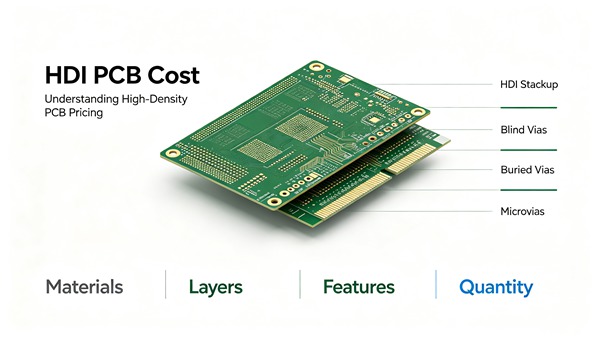
HDI boards may contain blind vias, buried vias, microvias, and sequential lamination structures.
These features introduce additional manufacturing steps and process dependencies.
For example, a stacked microvia structure may require multiple lamination and drilling operations.
Such boards can be difficult to expedite because the production stages must be completed in the correct sequence.
Special laminate materials
Specialty materials may not be available in the same quantities as standard FR-4.
Rogers, PTFE-based laminates, high-speed materials, and unusual dielectric constructions may require additional procurement coordination.
If the material is not in stock, the requested turnaround time may be limited by supplier availability rather than factory capacity.
Heavy copper construction
Heavy copper PCBs require careful control during imaging and etching.
Thicker copper can affect achievable trace width, spacing, and pattern definition.
Boards with high copper weights may therefore require a more carefully controlled production schedule.
Tight tolerances and special testing
A board requiring tight dimensional tolerances, controlled impedance, back drilling, or additional inspection may need more engineering and quality-control time.
The manufacturer must confirm that the required process capacity is available before committing to an accelerated delivery date.
How PCB Lead Time Changes Between Prototype and Production Orders
Prototype and production orders have different cost structures and scheduling requirements.
A prototype order usually contains a relatively small quantity and may be intended to support engineering verification or product development.
A production order requires material planning, stable process control, and consistent output across a larger quantity.
PCB prototype lead time
Prototype manufacturing often involves small quantities and a shorter planning cycle.
However, prototypes can still be difficult to expedite if they use unusual materials, complex layer structures, or special drilling requirements.
For example, a standard four-layer FR-4 prototype may be relatively straightforward to schedule, while a six-layer HDI prototype with blind and buried vias may require considerably more processing.
The prototype quantity alone does not determine delivery time.
Production PCB lead time
Production orders require more detailed planning.
Manufacturers may need to arrange material quantities, production panels, inspection capacity, and shipment schedules.
A larger quantity can increase the total processing time, especially if the order requires multiple production batches.
On the other hand, repeat production orders with an established specification may be easier to plan than a new design with unresolved manufacturing details.
Why prototype and production prices behave differently
A short prototype lead time may require priority scheduling, while a production order may benefit from better material planning and process efficiency.
The cost structure also changes with quantity, tooling, and setup requirements.
For a deeper comparison, see تكلفة النموذج الأولي للوحة الدوائر المطبوعة مقابل تكلفة الإنتاج: لماذا تتغير الأسعار.
How to Reduce PCB Lead Time Without Increasing Cost Too Much
A shorter delivery schedule does not always require an expensive rush order.
In many cases, better preparation and earlier decisions can remove delays before manufacturing starts.
Submit complete and verified fabrication files
Incomplete production data is a common source of avoidable delay.
Before submitting an order, check that the following files and specifications are available:
- Gerber or ODB++ files
- NC drill files
- مخطط المجلس
- Stackup information
- وزن النحاس
- السماكة النهائية
- تشطيب السطح
- عبر المواصفات
- Special manufacturing notes
If controlled impedance or other special requirements apply, include the relevant details rather than relying on a general note.
Confirm the material before ordering
Material selection should be finalized before the manufacturing schedule is confirmed.
If the project requires a specific Rogers series, high Tg laminate, or unusual thickness, check availability early.
Where the electrical requirements allow alternatives, discuss suitable standard materials with the manufacturer.
A readily available material may help avoid procurement delays.
Avoid unnecessary design changes after approval
Changes to layer count, board dimensions, drill sizes, stackup, or copper requirements can affect the production process.
A revised design may require a new engineering review or the restart of certain manufacturing stages.
Finalizing the fabrication data before approval helps protect the delivery schedule.
Use a practical layer count and via structure
Higher layer counts and advanced via structures can increase manufacturing complexity.
If the circuit can meet its requirements using a simpler construction, the board may be easier to produce.
This does not mean that engineers should remove necessary layers or vias simply to shorten lead time.
The design should be optimized for both electrical performance and manufacturability.
Confirm the surface finish early
Surface finish should be specified in the initial RFQ.
Changing from HASL to ENIG or another finish after production planning may affect process scheduling.
Selecting the finish based on component pitch, solderability, storage requirements, and application conditions helps avoid late changes.
Separate urgent prototypes from standard production
If only a small number of boards are needed immediately, consider whether the urgent requirement can be met with a prototype batch.
The remaining quantity can follow the normal production schedule.
This approach may be more economical than expediting the entire order.
However, both batches should use an approved and consistent design revision.
When Is Expedited PCB Manufacturing Worth the Additional Cost?
Rush production is useful when the value of receiving the boards earlier is greater than the additional manufacturing and logistics expense.
Typical situations include:
Engineering validation deadlines
A delayed prototype may affect testing, debugging, and product development milestones.
If a project team is waiting for physical boards to verify circuit behavior, an expedited order may help prevent a larger schedule delay.
Product demonstrations and customer evaluations
Some projects require working hardware for a scheduled demonstration or customer review.
In these situations, the delivery date may be more important than the additional fabrication cost.
Replacement boards for equipment failures
A replacement PCB may be required to restore equipment operation.
The cost of downtime can be much higher than the cost of an expedited manufacturing order.
Pilot production and pre-production testing
Pilot builds may need to be completed before a fixed production or qualification milestone.
Expedited PCBs can help maintain the overall project schedule when sufficient material and manufacturing capacity are available.
Rush production is not always the best choice. If the deadline is flexible, a standard schedule may offer better value.
How PCB Manufacturers Calculate Rush Order Charges
There is no universal formula for expedited PCB manufacturing.
Different manufacturers calculate rush charges according to production capacity, order complexity, material availability, and the requested delivery date.
The main cost components may include:
| عامل التكلفة | Why It May Increase the Price |
|---|---|
| Priority scheduling | The order may need to move ahead of normal production |
| Overtime labor | Additional shifts or extended working hours may be required |
| Material procurement | Urgent purchasing may increase material costs |
| Production separation | The order may not fit normal panel or batch planning |
| Special process coordination | Complex processes may need dedicated scheduling |
| Additional inspection coordination | Testing and inspection must fit the compressed schedule |
| Expedited shipping | Faster transportation may increase logistics costs |
Not every urgent order includes all these charges.
A simple board using available materials may require only a scheduling adjustment. A complex multilayer PCB with specialty laminates may involve several additional cost factors.
When comparing quotations, ask whether the quoted lead time refers to fabrication completion, shipment, or delivery to the final destination.
These are different milestones and should not be treated as interchangeable.
What Information Should Be Included When Requesting a Fast-Turn PCB Quote?
A clear RFQ helps the manufacturer evaluate whether the requested turnaround time is achievable.
Include the following information:
| Information | Why It Matters |
|---|---|
| Gerber or ODB++ files | Defines the fabrication requirements |
| عدد الطبقات | Helps estimate process complexity |
| مواصفات المواد | Determines material availability |
| أبعاد اللوحة | Affects panel planning and material use |
| وزن النحاس | Influences processing requirements |
| السماكة النهائية | Defines stackup construction |
| عبر البنية | Identifies drilling and lamination complexity |
| تشطيب السطح | Determines final processing requirements |
| الكمية | Affects production scheduling |
| Required delivery date | Defines the urgency of the order |
| Shipping destination | Helps estimate transportation time |
| Special testing requirements | Allows inspection capacity to be planned |
It is also useful to state whether the delivery date is a strict deadline or a preferred target.
This gives the manufacturer more flexibility when evaluating possible production arrangements.
TOPFAST can review PCB fabrication files and technical specifications to assess production feasibility and provide a quotation based on the requested schedule. For urgent projects, include the required delivery date when submitting the design.
Common Mistakes When Estimating PCB Lead Time Cost
Comparing lead times without checking the scope
One quotation may refer to fabrication completion, while another may include shipping.
Always confirm whether the stated time covers manufacturing only or the full delivery process.
Assuming every PCB can use the fastest production option
Complex multilayer boards, HDI constructions, and specialty materials may require more processing time.
The fastest schedule available for a simple two-layer PCB may not apply to a complex high-density design.
Ignoring material availability
A manufacturer may have sufficient production capacity but still be unable to start immediately because the specified laminate is unavailable.
Confirming material availability is especially important for specialty PCB projects.
Requesting rush production before the design is finalized
Last-minute changes can interrupt manufacturing and invalidate the original schedule.
The fabrication files, stackup, and special requirements should be confirmed before the order enters production.
Focusing only on fabrication time
Shipping, customs clearance, and delivery arrangements can affect the actual arrival date.
A short factory lead time does not necessarily mean the finished boards will reach the destination immediately.
Frequently Asked Questions About PCB Lead Time Cost
Not necessarily. Some orders can be completed quickly within a manufacturer’s normal production schedule, especially when the design is simple and materials are available.
Additional charges are more likely when the requested delivery date requires priority scheduling, overtime, urgent procurement, or special production arrangements.
A fast-turn prototype may need to be prioritized ahead of other orders.
The manufacturer may also need to coordinate materials, production equipment, labor, and inspection within a shorter period.
The actual rush charge depends on the board’s complexity and the production capacity available.
Simple two-layer and standard four-layer FR-4 boards are generally easier to schedule than complex multilayer, HDI, or specialty-material designs.
However, material availability, order quantity, and current factory capacity also matter.
Yes. Higher layer counts usually require additional inner-layer processing and lamination.
The effect becomes more significant when the board includes blind vias, buried vias, sequential lamination, or tight registration requirements.
Yes. Standard FR-4 is generally easier to source than specialized laminates.
A specific Rogers series, PTFE material, unusual dielectric thickness, or heavy copper configuration may require additional procurement time.
No. Fast-turn fabrication reduces the time required to manufacture the PCB. Expedited shipping reduces the transportation time after the boards are ready.
Both may be necessary to meet a tight delivery deadline.
In many cases, yes.
Submitting complete files, confirming material availability, finalizing the stackup, and avoiding design revisions can reduce avoidable delays.
For projects with flexible deadlines, standard production scheduling is generally more economical than requesting priority manufacturing.
Confirm the manufacturing lead time, material availability, production scope, inspection requirements, shipping method, and estimated arrival date.
Also ask whether the quoted schedule is a confirmed production commitment or an estimated target.
الخاتمة
PCB lead time affects manufacturing cost because urgent orders may require production priority, additional labor, material coordination, and changes to normal scheduling.
The amount of extra cost depends on the board’s complexity, material availability, layer count, via structure, quantity, and the delivery date requested.
A standard FR-4 prototype may be relatively straightforward to expedite, while a high-layer-count HDI board using specialty materials may require more time even when priority production is available.
The most effective way to control lead time cost is to prepare complete fabrication files, confirm materials early, finalize the stackup, and distinguish between genuine deadline requirements and preferred delivery dates.
If your project has a fixed delivery deadline, provide the Gerber files, technical specifications, quantity, and required arrival date when requesting a quotation. TOPFAST can review the manufacturing requirements and assess a suitable production schedule for your PCB project
 AR
 EN
 PT
 DE
 FR
 ES